Product Overview
The PYN-E560 is a domestically developed LED external quantum efficiency (EQE) measurement system independently developed by Pynect (Shenzhen Pynect Science and Technology Co., Ltd.), providing complete quantum-yield testing solutions for LED chip, luminescent-material and luminaire manufacturers. The system integrates a scientific-grade spectrometer, a 50mm electroluminescence integrating sphere, an 8-channel probe station, a radiometric calibration light source and ElectronView measurement software, enabling automated measurement of EQE, luminance, radiant exitance, luminous efficacy (CE), peak wavelength and T70/T50 lifetime. Compatible with Keithley and Keysight source meters, it is a domestic alternative to imported EQE test systems.
1. Key Features
- Scientific-grade spectrometer: 350-1100nm wavelength range, back-illuminated cooled area CCD (TEC-cooled), dark noise as low as 2.5 counts RMS, dynamic range 85000:1.
- 50mm electroluminescence integrating sphere (EL-SP-50): High-purity PTFE, SMA905 optical interface, sample port and cover customized on demand, with a 9mm-aperture radiometric calibration cover.
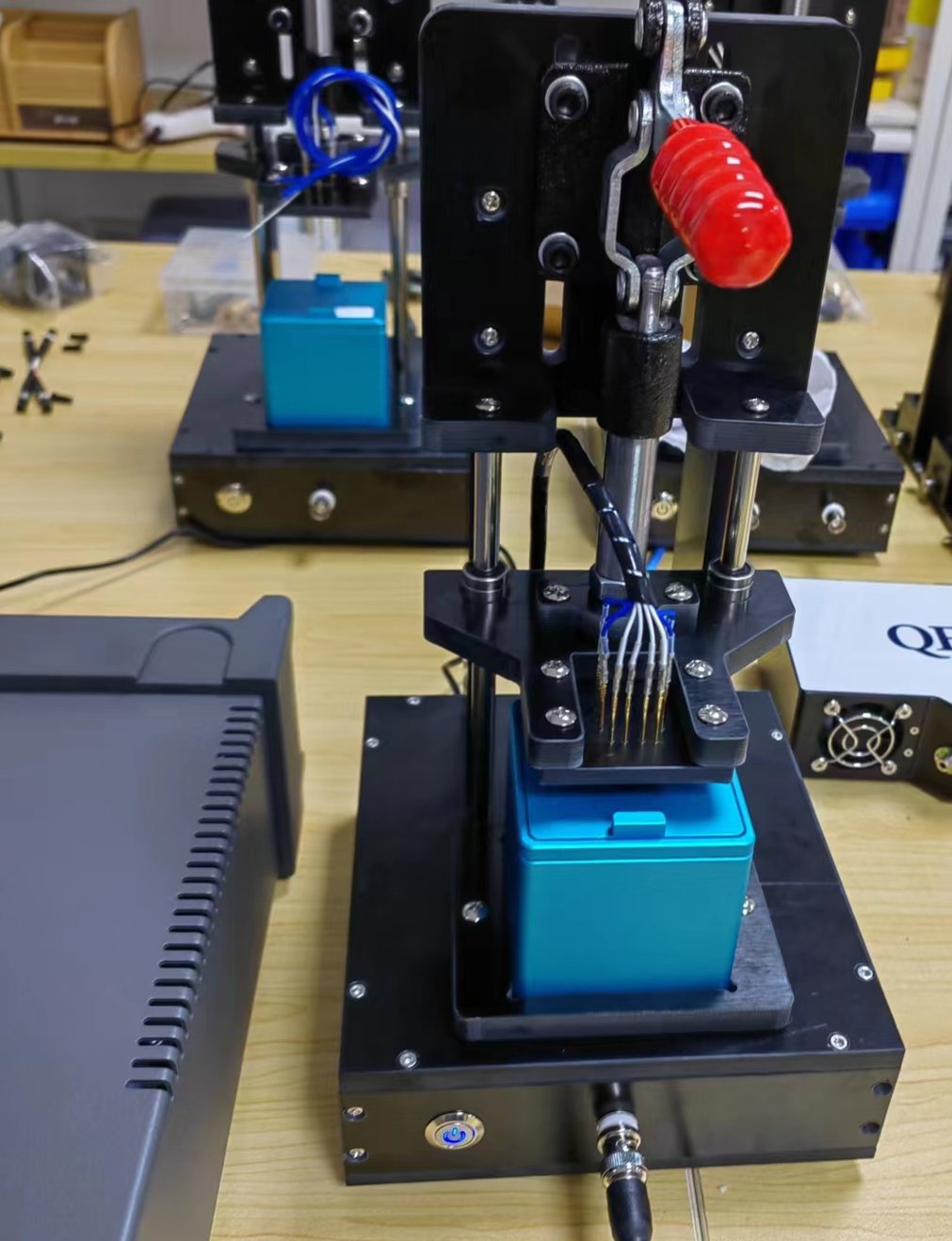
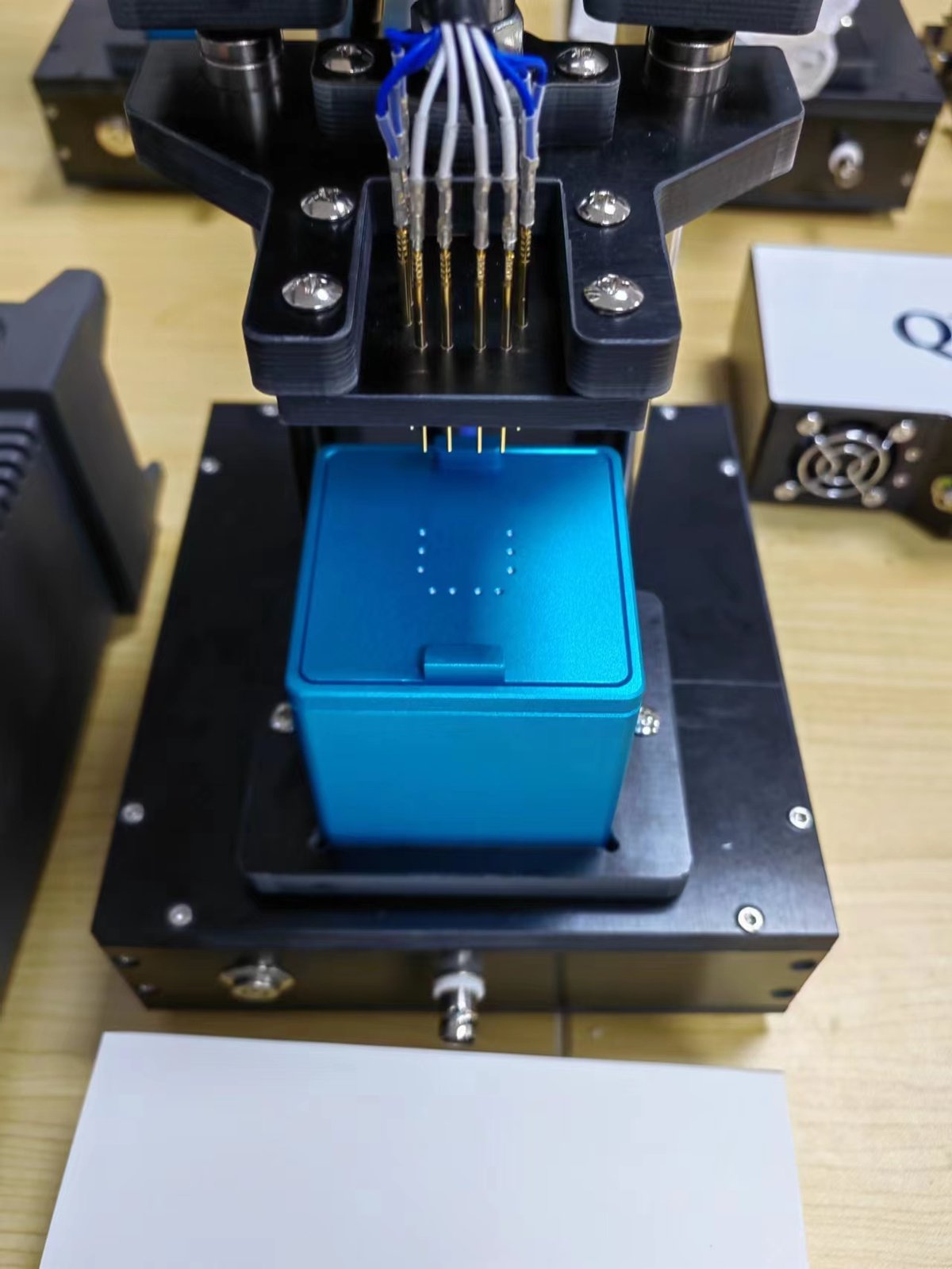
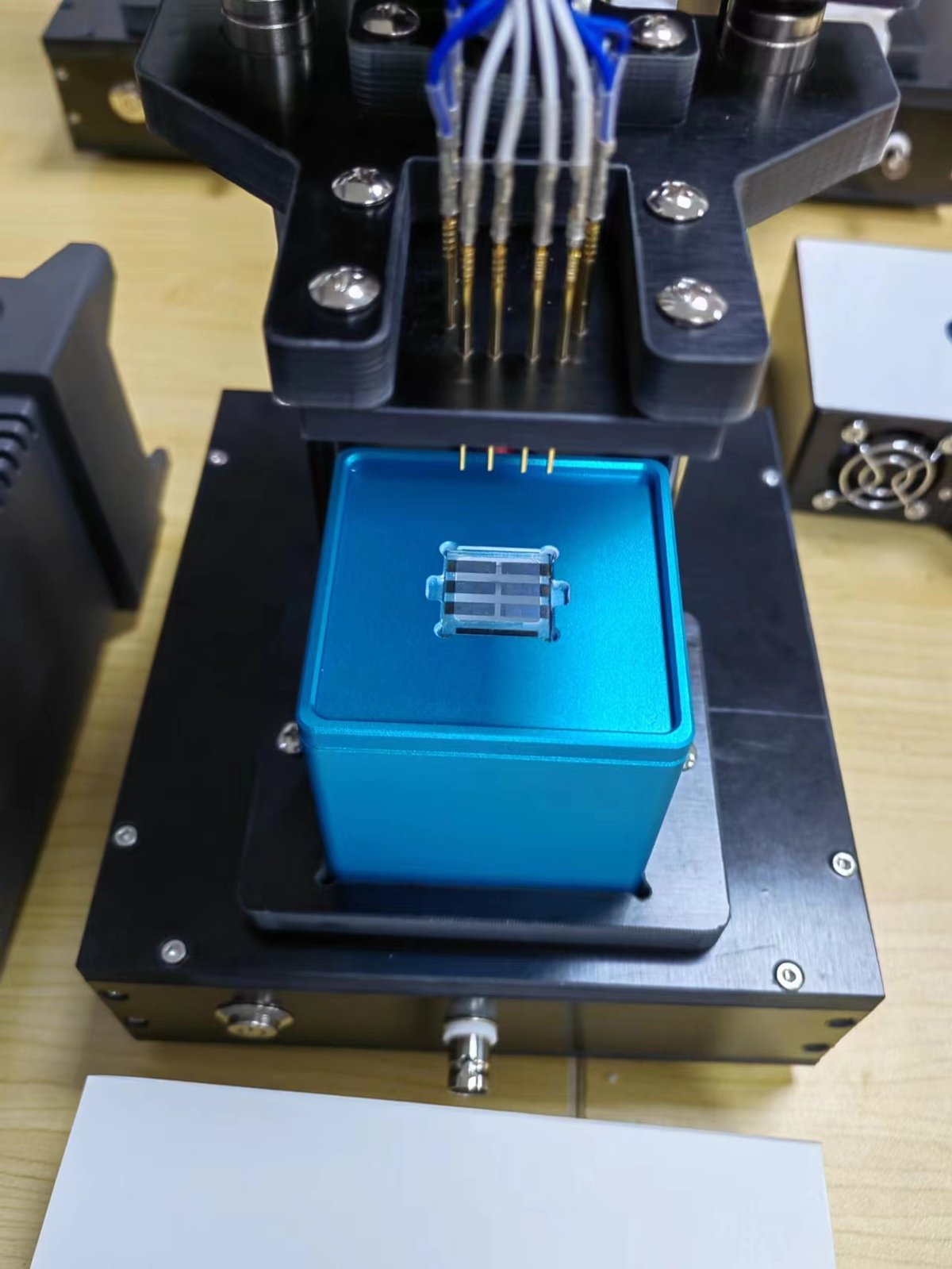
- 8-channel probe station (EL-PS): Software-controlled channel switching, Modbus protocol over RS232, 0.8mm ball-tip probes, stage travel ≥40mm; automated measurement of up to 8 LED emission points.
- Radiometric calibration source (HL 3plus-CAL): 350-1100nm tungsten lamp, stability pp≤0.5%, mechanical shutter, supports absolute optical power calibration in μW/cm²/nm.
- Professional measurement software ElectronView: Real-time EQE, luminance, radiant exitance, luminous efficacy (CE) and peak wavelength versus current density or voltage, with T70/T50 lifetime testing (customizable thresholds).
- Broad source-meter compatibility: Compatible with Keithley 2400, 2450 and 2600 series and Keysight B2901/B2902 source meters; other source meters can be supported through custom development - contact us.
2. Specifications
2.1 System Parameters
| Component | Item | Parameter |
|---|---|---|
| Scientific-grade spectrometer (PY-E500) | Wavelength range | 350-1100nm |
| Slit width | 50μm | |
| Detector | Back-illuminated cooled area CCD | |
| Dark noise | 2.5 counts RMS | |
| Dynamic range | 85000:1 | |
| Cooling | TEC | |
| Calibration source (HL 3plus-CAL) | Wavelength range | 350-1100nm |
| Lamp | Tungsten lamp | |
| Stability | pp≤0.5% | |
| Calibration unit | μW/cm²/nm | |
| Shutter | Yes | |
| Power | 12V/1.5A | |
| Electroluminescence integrating sphere (EL-SP-50) | Inner diameter | 50mm |
| Material | High-purity PTFE | |
| Sample port | Customized on demand | |
| Sample cover | Customized on demand | |
| Radiometric calibration cover | 9mm aperture | |
| Optical interface | SMA905 | |
| Probe station (EL-PS) | Channels | Up to 8 |
| Switching | Software-controlled | |
| Protocol | Modbus | |
| Interface | RS232 | |
| Source-meter interface | BNC | |
| Probes | 0.8mm ball-tip | |
| Stage travel | ≥40mm | |
| Source meter (Keithley 2450) | Voltage range | 20 mV - 200 V |
| Current range | 10 nA - 1 A | |
| Bias accuracy | 0.012% | |
| Sweep modes | Linear, Log, Dual Linear, Dual Log, Custom, Source-Memory | |
| Reading buffer | >250,000 points | |
| Reading rate | >3000 readings/second | |
| Programming | SCPI, TSP | |
| Interfaces | GPIB, USB, Ethernet (LXI) | |
| Fiber (FB-N600-1M-PV) | Wavelength range | 300-2500nm |
| Core diameter | 600μm |
2.2 Appearance and Structure
2.3 System Components
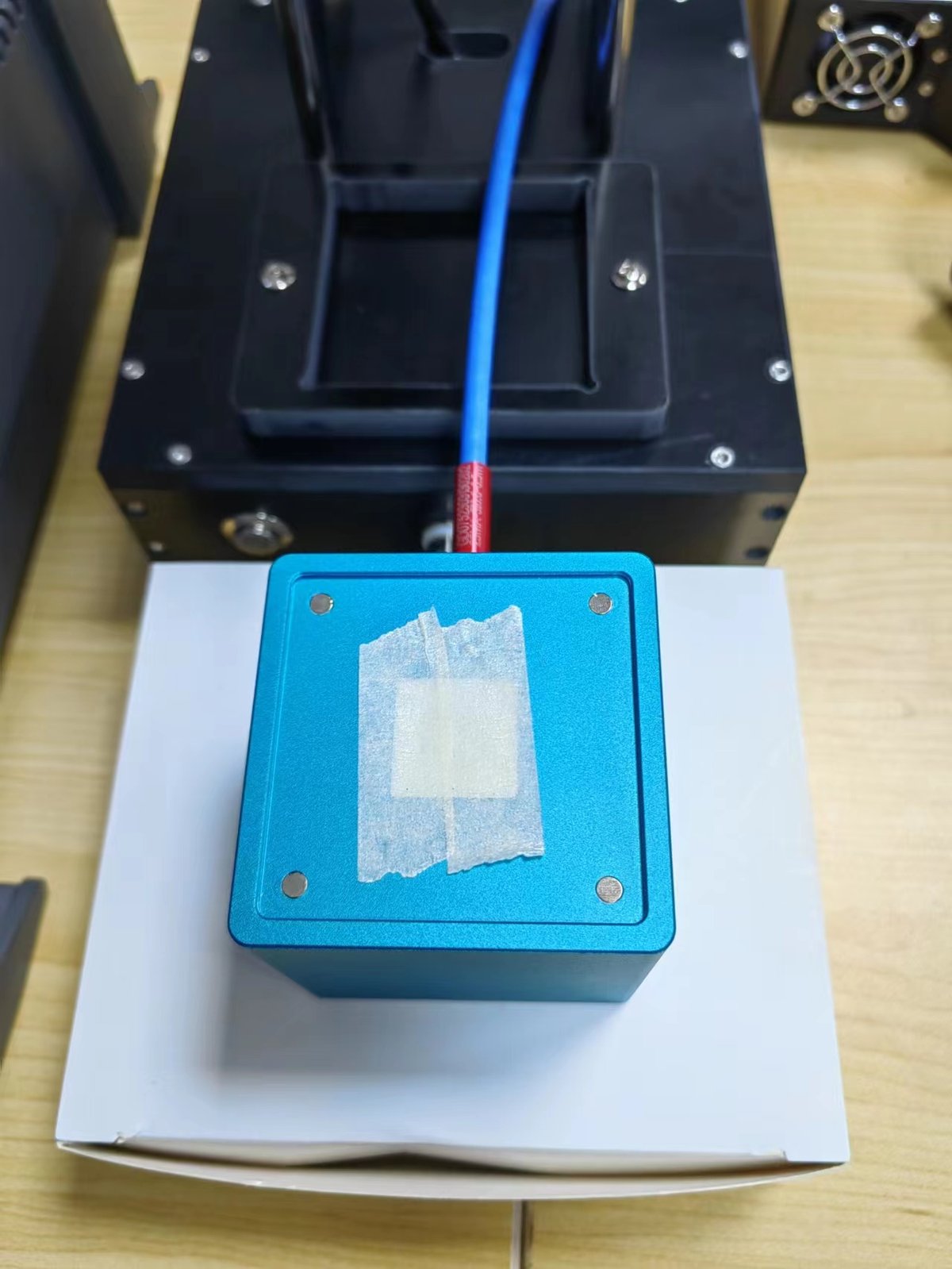
Integrating sphere with radiometric calibration cover
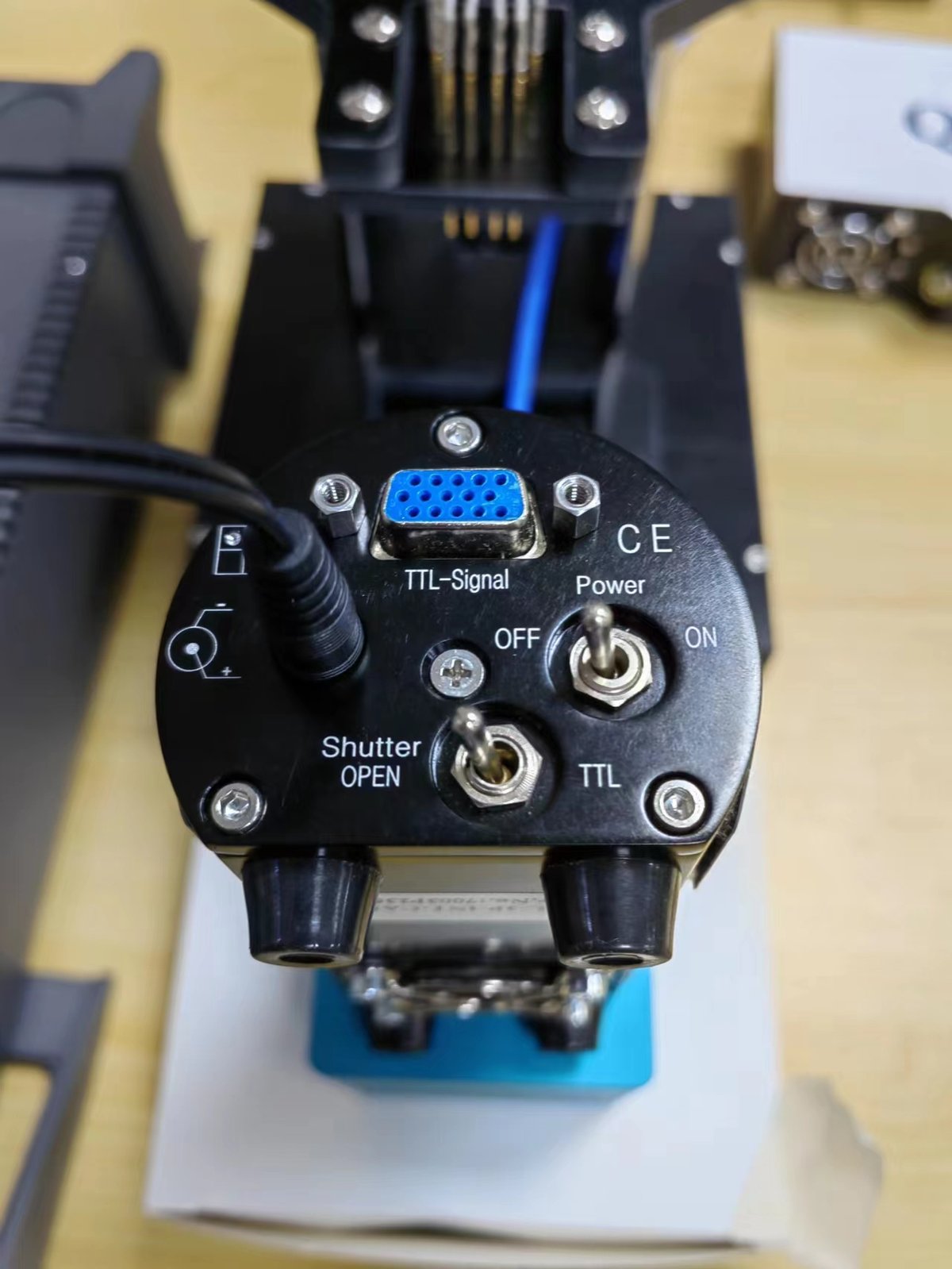
Radiometric calibration light source
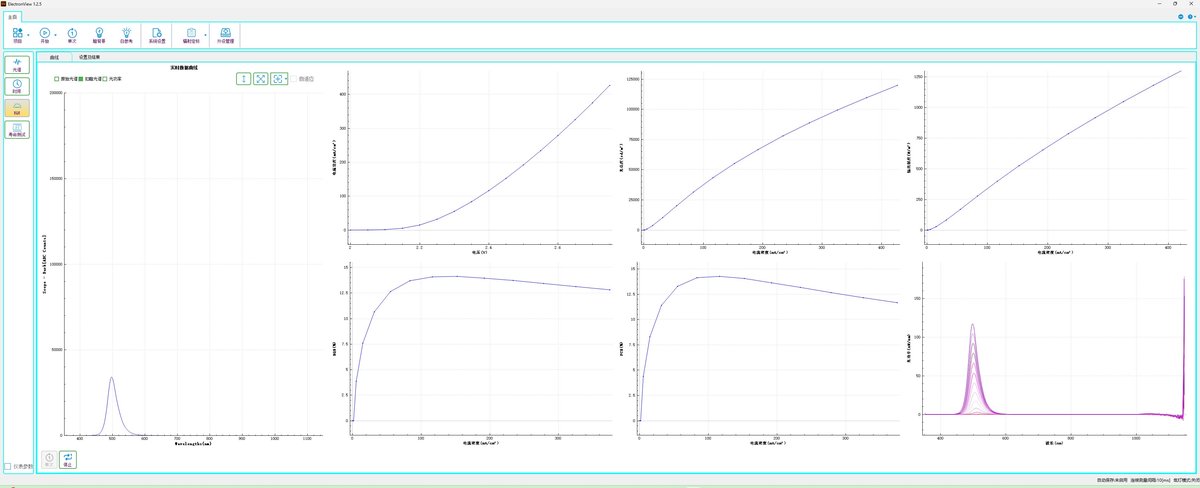
EQE measurement software interface
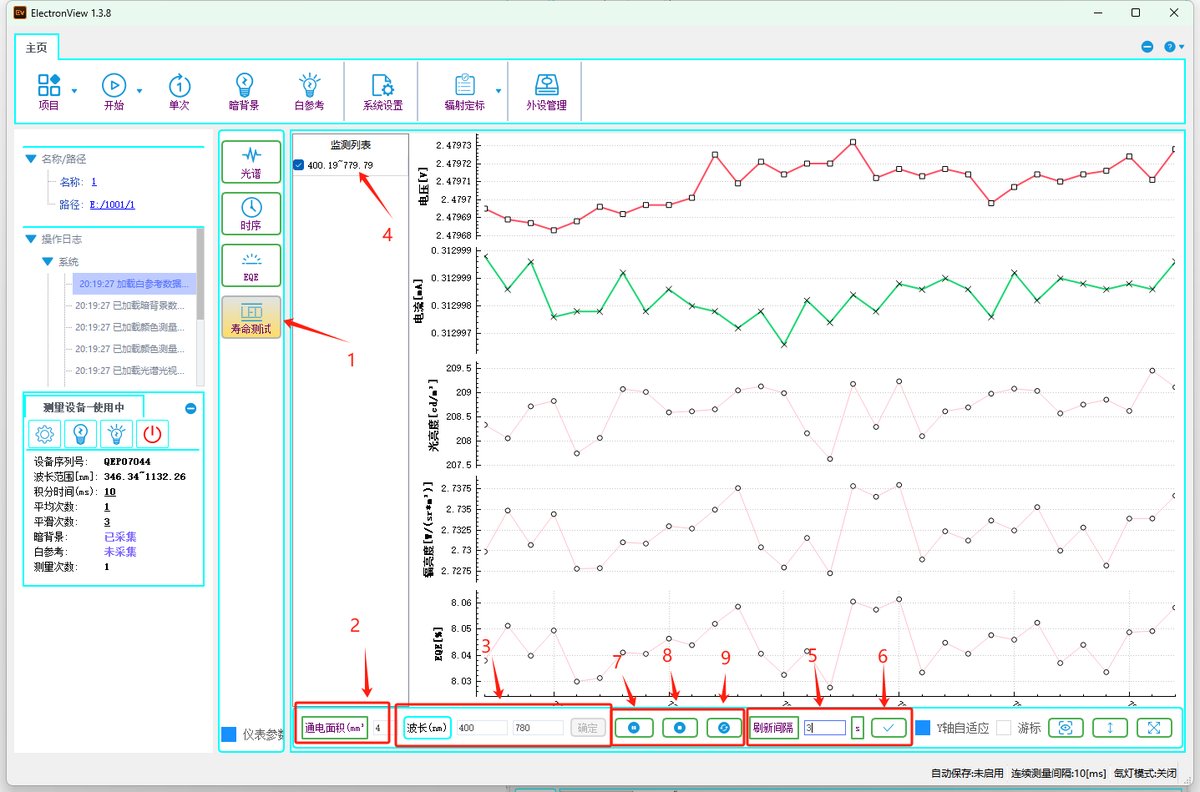
LED lifetime test interface
3. Measurement Principle
The external quantum efficiency (EQE) of an LED is the ratio of emitted photons to injected electrons - the core metric of LED electro-optical conversion efficiency. The PYN-E560 measures JV curves, optical power, luminance, radiant exitance, EQE and lifetime:
- Radiometric calibration: The HL 3plus-CAL calibration source converts the relative spectral distribution acquired by the spectrometer into an absolute optical power distribution (μW/cm²/nm), ensuring consistent results across different spectrometers; re-calibration is required after disassembling the optical path.
- Electrical acquisition: The source meter sweeps according to the configured voltage range and step, acquiring voltage and current in real time; current density is calculated using the LED emission area.
- Optical acquisition: The integrating sphere collects the LED emission, and the scientific-grade spectrometer acquires the 350-1100nm spectrum; absolute optical power, luminance and photon counts are calculated with the radiometric calibration coefficients.
- Parameter calculation: The software computes EQE from the ratio of emitted photons to injected electrons and simultaneously reports luminous efficacy (CE), peak wavelength and other quantities versus current density or voltage.
- Lifetime testing: In constant-current mode, the optical output decay curve is automatically acquired at set intervals to calculate T70/T50 lifetime.
4. Typical Measurement Workflow
- Radiometric calibration: Fit the EL-SP-50 calibration cover -> warm up the HL 3plus-CAL source for 5 minutes -> set the integration time so spectral intensity approaches 100,000 counts -> load the lamp file -> set the shutter to the middle position to store the dark background -> set the shutter to OPEN to save the calibration-source relative spectrum (S0) -> calculate and save the calibration coefficients.
- Connect peripherals: In ElectronView's peripheral management, connect the source meter and probe station, and select the source-meter model (Keithley 2400/2450) and the corresponding serial port/device number.
- EQE measurement: Enter the energized area, settling time (default 100ms), start/stop/step voltages and wavelength range (default 380-780nm), place the LED sample and press down the handle, click continuous measurement, and view the four live curves: EQE, current density-voltage, luminance-current density and radiant exitance-current density.
- Data export: The EQE table can be saved to a file; optical power data at each voltage step is automatically saved to the project data directory (filename: probe-number-time-Power.csv).
- Lifetime testing: Configure a single-step constant-current output (manual current-range selection recommended) and the measurement interval; optical output decay is recorded automatically to calculate T70/T50 lifetime.
5. Software and Downloads
- ElectronView measurement software: Professional software developed by Pynect for the PYN-E560 series EQE measurement system; supports radiometric calibration, EQE measurement and LED lifetime testing, compatible with Keithley and Keysight source meters. Software download and version notes
- User manual: Covers unboxing, hardware connection, software installation, parameter configuration, measurement workflow, data export and troubleshooting. Download the user manual
6. Applications
- EQE, luminance and luminous-efficacy testing of LED chips and packaged devices
- LED electro-optical performance research and teaching experiments at universities and research institutes
- LED device aging and lifetime verification (T70/T50)
- Incoming quality inspection and reliability sampling in the display and lighting industries
- Electro-optical characterization of emerging emitters such as Micro-LEDs
7. Selection and Configuration Guidance
- The spectrometer can be selected according to band and sensitivity requirements;
- Source meters support the Keithley 2400/2450/2600 series and Keysight B2901/B2902 by default; contact us for custom support of other source meters;
- Sample ports and covers are customized on demand: provide your LED sample dimensions, and we will produce engineering drawings for confirmation before machining;
- Contact us for more than 8 channels or special sample fixtures (e.g., Micro-LED probes).
8. Precautions
- On Windows 10 or later, install ElectronView to the C drive in administrator mode to avoid permission issues that cause software registration failure.
- If the Keithley 2450 (USB) cannot be opened, the driver is usually not installed correctly; for the Keithley 2400 (RS232), confirm the correct COM port number in Device Manager.
- The Ocean Optics spectrometer driver must be installed on first installation.
- After radiometric calibration, do not casually remove the fiber or integrating sphere; otherwise re-calibration is required.
- The probe tip has some elasticity; contact with the sample is achieved by the weight of the handle - no continuous pressing is needed.