1. Key Features
- Enclosed transmission measurement structure: Built on the NIR-M-T11 module with an added enclosure and external Type-C interface; simply insert a cuvette to perform liquid transmission measurements.
- Covers the 1350-2150nm band: Suited for near-infrared absorption analysis of solutions, beverages, fermentation broths, medicinal liquids, organic solvents and other samples.
- Integrated light source and cuvette holder: Built-in light source, collimated optical path and cuvette holder reduce external optical-path assembly work.
- Interface better suited for complete instruments: Converts the bare-board Micro USB to Type-C, convenient for field testing and customer demonstrations.
- Note the path length for water-containing samples: Aqueous solutions absorb strongly above 1400nm; method development should prioritize a short path length within 2mm or a dilution approach.
2. Specifications
2.1 Technical Parameters
| Item | Parameter |
|---|---|
| Model | NIR-T310 |
| Type | Enclosed transmission near-infrared spectrometer |
| Internal spectrometer module | NIR-M-T11 |
| Added instrument configuration | Enclosure, Micro USB to Type-C interface |
| Wavelength range | 1350-2150nm |
| Signal-to-noise ratio | 3000:1 @ 2000nm |
| Optical resolution | Typ. 12nm |
| Wavelength accuracy | Typ. ±1 nm |
| Detector | 1mm standard InGaAs (uncooled) |
| Slit size | 1.8mm × 0.025mm |
| Light source | Built-in 0.7W tungsten lamp |
| Cuvette holder | Standard 10mm cuvette holder; 2mm or shorter path recommended for water-containing samples |
| Measurement mode | Cuvette transmittance / absorbance |
| Communication interface | Type-C (UART expandable) |
| Power supply | USB or UART powered |
| Power requirement | 5V DC, min. 0.5A DC |
| Operating temperature | 0-40°C, RH max. 85% |
| Dimensions | 120mm × 100mm × 70mm |
| Weight | Depends on the enclosure and interface configuration |
2.2 Structure and Dimensions
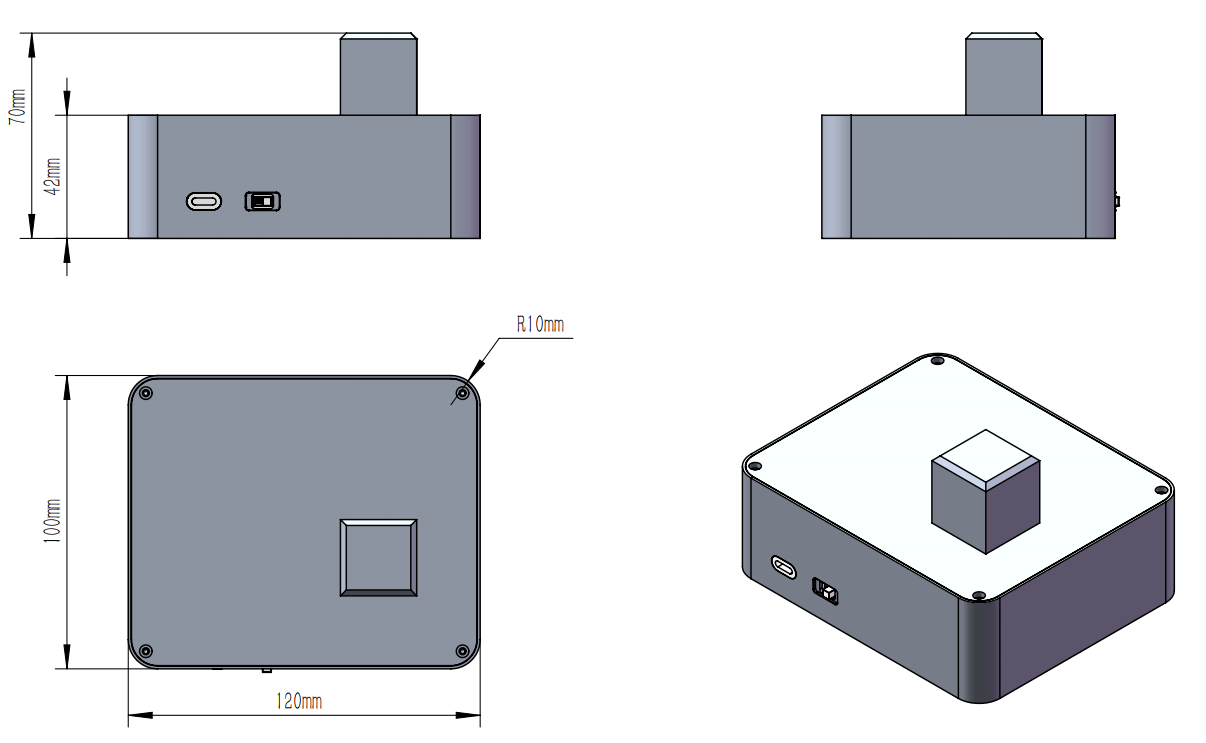
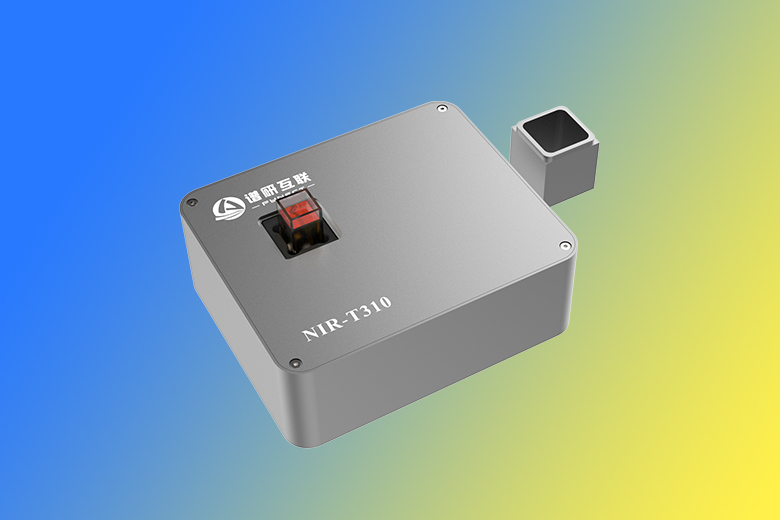
3. Applications
The NIR-T310 is primarily used for liquid-transmission near-infrared measurement. It fits on a laboratory bench, teaching platform or in compact equipment for absorbance acquisition of solutions, beverages, fermentation broths, medicinal liquids, organic solvents and process liquids.
For water-containing systems, prioritize short-path cuvettes, dilution or filtration to control absorption saturation. All display spectra involving water or aqueous solutions follow the 2mm-or-shorter short-path principle.
| Application | Description |
|---|---|
| Beverage and alcohol analysis | For sugar content, alcohol content, formulation consistency or process-change tracking. |
| Medicinal liquid and excipient testing | For medicinal-liquid composition, excipient variation and batch-consistency analysis. |
| Fermentation process monitoring | Track absorption changes related to sugars, alcohols, organic acids and moisture. |
| Organic solvents and oils | For acquiring C-H related absorption features and developing qualitative/quantitative models. |
| Teaching and method development | The integrated design lowers the optical-path assembly barrier, convenient for near-infrared experimental teaching. |
4. Typical Spectra
4.1 Typical Optical Path
The NIR-T310 uses an integrated cuvette transmission optical path: continuous near-infrared light from the built-in tungsten lamp is collimated and passes through a standard 10mm cuvette; the sample selectively absorbs light at different wavelengths, and the transmitted light enters the DLP near-infrared spectrometer module for dispersion and detection. Users need no external fiber, separate light source or cuvette holder - simply measure the blank reference and the sample in turn to obtain transmittance or absorbance spectra.
A typical measurement workflow is as follows:
- Insert a cuvette filled with blank solvent or blank matrix and acquire the Reference as the 100% transmittance reference.
- Insert a cuvette filled with the liquid under test and acquire the Sample.
- In routine calculation no separate baseline is acquired; transmittance is computed directly from the Sample and Reference, then converted to absorbance.
4.2 Typical Spectra
Transmission-mode near-infrared measurements typically use absorbance spectra as the modeling input. For liquid samples, the 1350-2150nm band lies in the long-wavelength near-infrared region, where overtone and combination absorption information from hydrogen-containing groups such as O-H, C-H and N-H can be observed. This band covers key absorptions such as the second overtone of the water molecule O-H bond (around 1440nm) and the first overtone of C-H and N-H bonds, and is widely used in concentration analysis of moisture, alcohols, sugars and some organics. When building models, it is recommended to apply preprocessing such as smoothing, normalization, SNV, first derivative or second derivative to the absorbance spectra to reduce the impact of light-source fluctuation, cuvette differences and temperature drift on the model.
Because the NIR-T310 has a fixed integrated transmission optical path, typical spectra should be based on results acquired from actual samples and the blank reference. For product display, prioritize measured absorbance curves of liquid samples such as aqueous ethanol, sugar water, beverages or medicinal liquids; do not substitute spectra from reflectance-type samples or external optical paths.
The images below are illustrative spectra drawn from typical absorption characteristics and do not represent measured data for this model. When drawing display spectra of water-containing samples, the path length is uniformly kept within 2mm to avoid spectral saturation from the strong absorption of water above 1400nm at a 10mm path length; non-aqueous samples are labeled with their actual experimental path length.
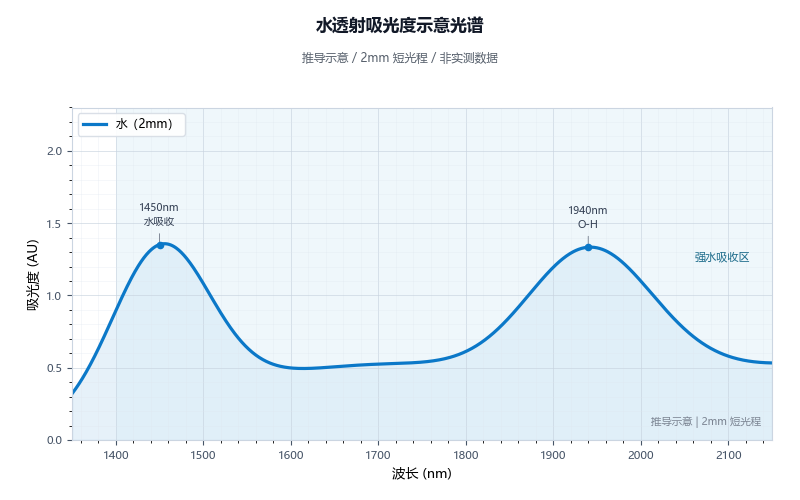
Water transmission absorbance spectrum
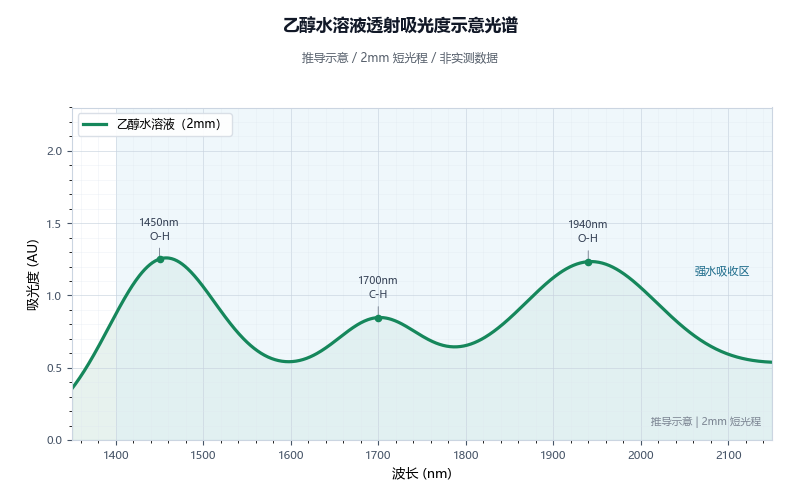
Aqueous ethanol transmission absorbance spectrum
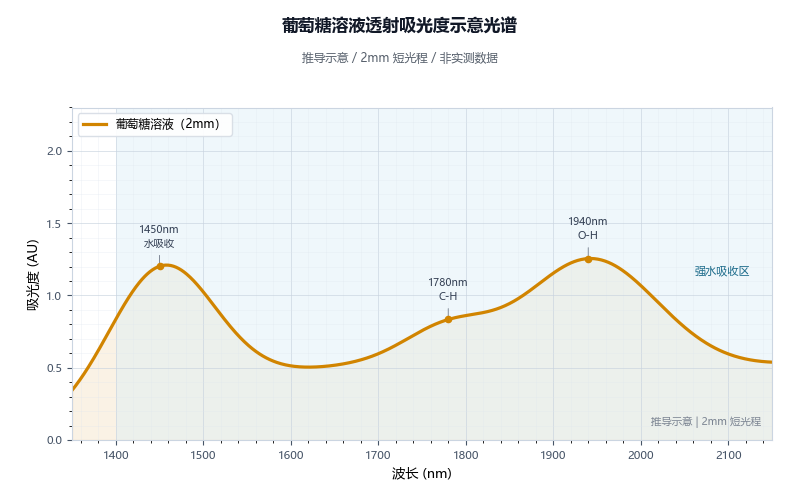
Glucose solution transmission absorbance spectrum
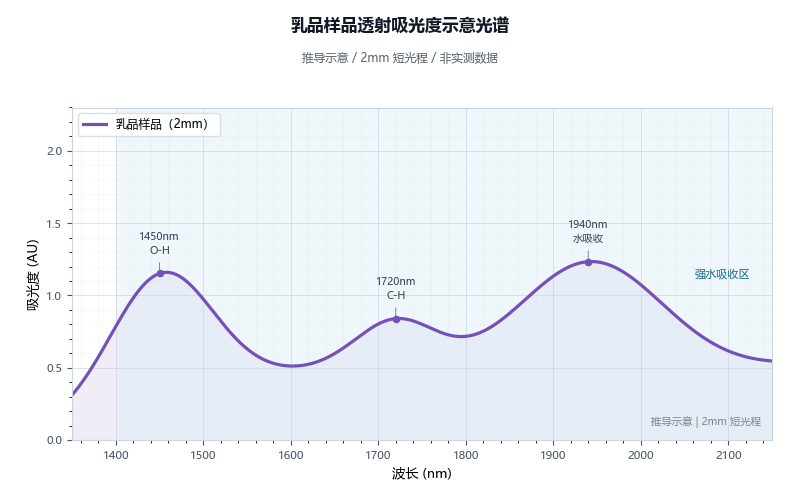
Dairy sample transmission absorbance spectrum
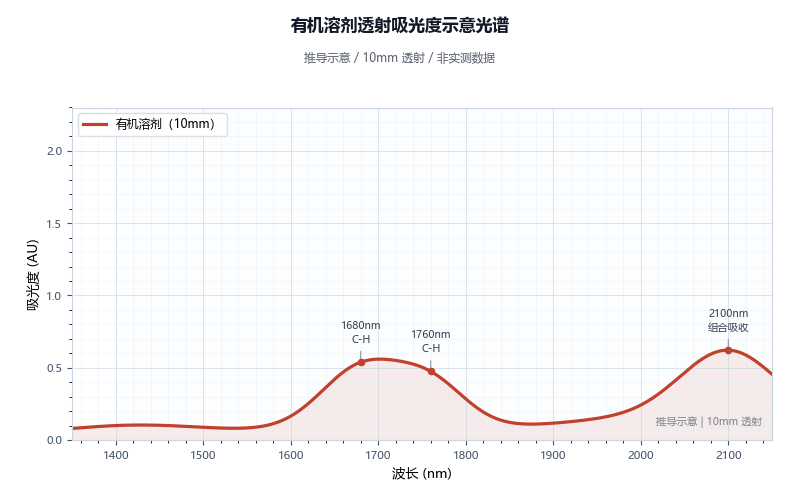
Organic solvent transmission absorbance spectrum
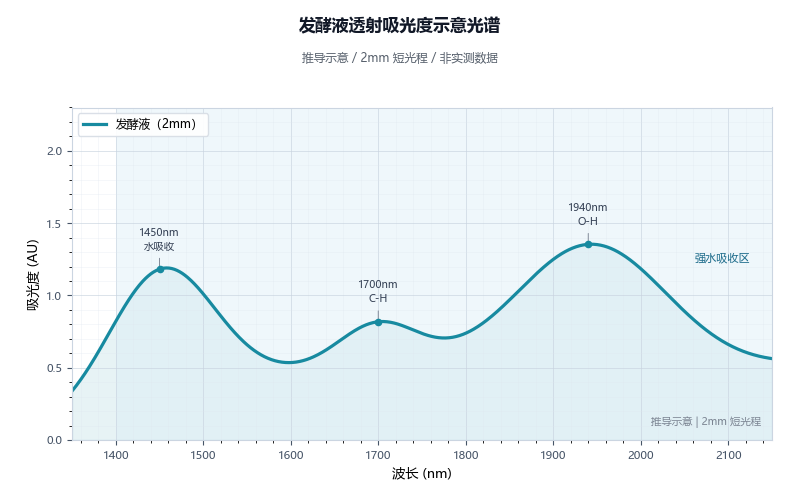
Fermentation broth transmission absorbance spectrum
5. Ordering Information
The NIR-T310 is a transmission near-infrared spectrometer with an integrated light source, collimated optical path and standard cuvette holder. Routine liquid transmission measurements do not require a standard reflectance white reference; prepare blank solvent, quartz cuvettes, and filtration or centrifugation consumables according to the sample system. If the sample absorbs too strongly or is turbid, prioritize a short path length, dilution or sample pretreatment to reduce saturation and scattering error.
| Product | Model | Quantity | Unit price | Amount (CNY) |
|---|---|---|---|---|
| Transmission near-infrared spectrometer | NIR-T310 | 1 | 44990 | 44990 |
| Total | 44990 |
The above prices are for website selection display. Actual quotations are adjusted according to enclosure, interface, software, accessories, calibration and order quantity; formal purchasing is subject to the sales quotation.
6. Technical Principle
6.1 Chemical Principle
Near-infrared spectroscopy belongs to molecular vibrational spectroscopy. Fundamental molecular vibrations lie mainly in the mid-infrared region, while overtone and combination transitions fall into the 700-2500nm near-infrared region. This product covers the 1350-2150nm band and can obtain characteristic absorption information of hydrogen-containing groups such as O-H, C-H and N-H, suitable for qualitative identification, content prediction and process monitoring combined with chemometric models.
Near-infrared spectra usually do not rely on a single peak; models are built by combining absorption features across multiple bands. In practical projects, preprocessing and modeling methods such as smoothing, normalization, SNV, first derivative, second derivative, MSC or PLS are often used to reduce the influence of sample form, optical-path differences, scattering and temperature drift.
6.2 Optical Principle
The optical path of the NIR-T310 consists of a built-in tungsten lamp, collimating optics, a fixed 10mm cuvette holder and a DLP near-infrared spectrometer module. Continuous near-infrared radiation emitted by the light source is collimated and passes through the cuvette sample cell; the sample selectively absorbs different wavelengths, and the transmitted light enters the spectrometer module for dispersion and detection. This optical path structurally fixes the relative positions of the light source, sample cell and entrance slit, reducing repeatability errors caused by external optical-path assembly, fiber coupling and holder alignment.
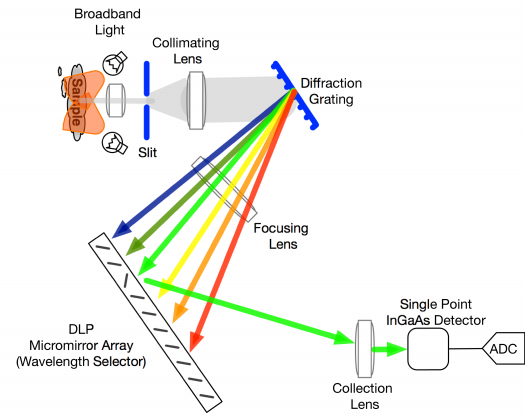
Inside the spectrometer module, a DLP grating dispersion architecture is used. Light passes through the slit and is collimated onto the grating, where it is dispersed by wavelength; the dispersed light of different wavelengths is directed side by side onto the digital micromirror array (DLP) mirrors. Each micromirror is programmed in turn to reflect the corresponding wavelength onto a single-point InGaAs detector, and the signal is then converted to digital form by the ADC and resolved into a spectral curve. The schematic diagram is as follows:
6.3 Measurement Principle
A transmission instrument typically first acquires a reference spectrum with a blank cuvette or solvent, then acquires the sample spectrum; the software computes transmittance or absorbance from the transmitted signal. For water-containing samples, especially in the high-absorption region above 1400nm, prioritize a short path length within 2mm, dilution or reduced concentration to avoid signal saturation.
7. Usage Guide
7.1 Software Usage
- Connect to the computer via Type-C and open the companion software; warm up the light source before blank and sample measurement.
- First insert the blank or solvent cuvette to acquire the reference spectrum, then insert the sample cuvette to acquire the sample spectrum.
- Set the integration time, number of averages and data saving mode according to the sample absorption intensity, and keep the same method parameters consistent.
7.2 Precautions
- Aqueous solutions are not suitable for direct use with a 10mm long path length in the high-absorption near-infrared region; prioritize cuvettes of 2mm or shorter.
- Keep the cuvette outer walls clean to prevent fingerprints, water droplets and scratches from affecting the transmission optical path.
- Avoid bubbles, sediment and suspended particles in the sample as much as possible; if unavoidable, standardize the sampling and settling procedures.
- Keep light-source warm-up, cuvette orientation and liquid fill height consistent to facilitate building a stable model.
7.3 FAQ
Q1: Why is a 10mm path length not recommended directly for water-containing samples?
A: Water absorbs very strongly above 1400nm; a 10mm path length can easily reduce the effective transmitted light to nearly zero, causing distortion or saturation in the high-absorbance region. A short path length is more suitable for near-infrared water-containing systems.
Q2: How to choose among the T210, T310 and T320?
A: The three mainly differ in wavelength range and the characteristic absorption regions of the target samples. For common moisture, sugar and basic liquid analysis, consider the T210 first; the mid- and long-wavelength models are better suited to fats, proteins and complex organic systems.