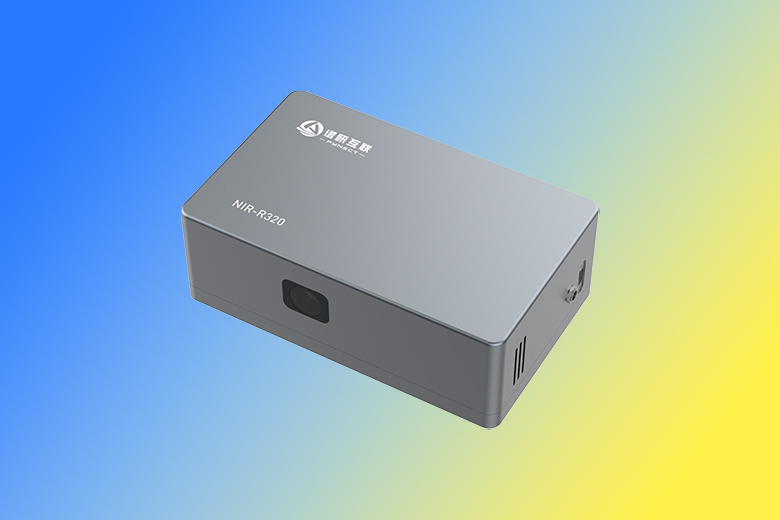
1. Key Features
- 900-2400nm wide-band reflectance measurement: Packaged around the NIR-M-R15 wide-band module, covering the common short-wave to long-wave characteristic regions of NIR.
- Large-area sampling window: Sapphire scanning window with a typical acquisition area of about 16mm in diameter, suitable for granules, powders, sheets and non-uniform samples.
- Stable contact measurement: The working distance includes the sample container thickness; sensitivity is better within 5mm, with about 2mm as the recommended working distance.
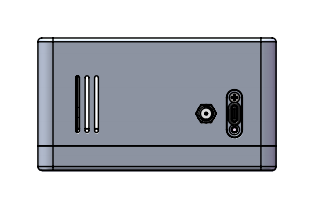
- More direct whole-unit interface: Adds housing protection and provides a Type-C interface externally, used with a 5V/3A power adapter.
- Suited for high-information-content modeling: The wide band can simultaneously cover multiple absorption features such as moisture, protein, fat, starch, plastic and pharmaceutical excipients.
2. Specifications
2.1 Technical Parameters
| Item | Parameter |
|---|---|
| Model | NIR-S-R16 |
| Product type | Wide-band housed reflectance NIR spectrometer |
| Internal spectrometer module | NIR-M-R15 |
| Added whole-unit configuration | Housing, Micro USB to Type-C interface |
| Wavelength range | 900-2400nm |
| Signal-to-noise ratio | 3000:1 @ 2200nm |
| Optical resolution | 10-12nm |
| Wavelength accuracy | Typ. ±1nm |
| Detector | InGaAs (uncooled) |
| Slit size | 1.8mm × 0.025mm |
| Scan mode | Linear / Hadamard / Slew Scan |
| Light source | Single 5W tungsten lamp with reflector |
| Scanning window | Sapphire glass |
| Acquisition area | Typ. 16mm diameter |
| Recommended working distance | 2mm optimum, better sensitivity within 5mm |
| Measurement mode | Large-window diffuse reflectance / contact reflectance |
| Communication interface | USB-C |
| Power supply | 5V / 3A power adapter |
| Operating temperature | 0-40°C, RH Max. 85% |
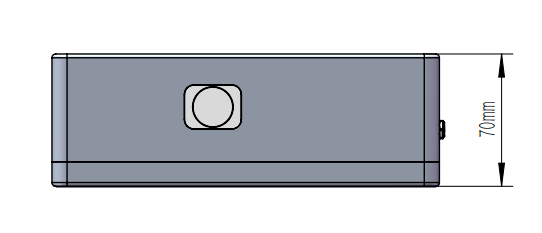
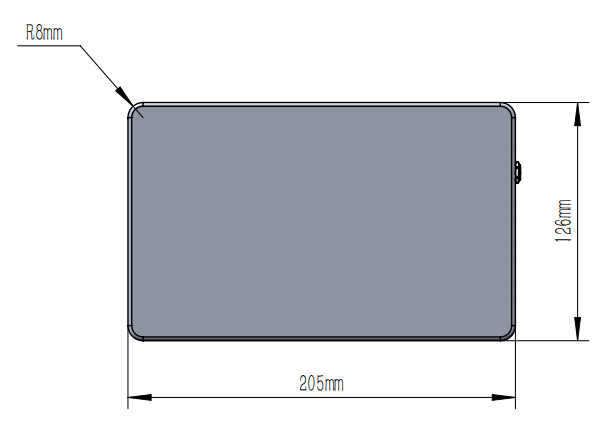
| Dimensions | 208mm × 126mm × 70mm |
| Weight | < 1.5kg |
2.2 Structure and Dimensions
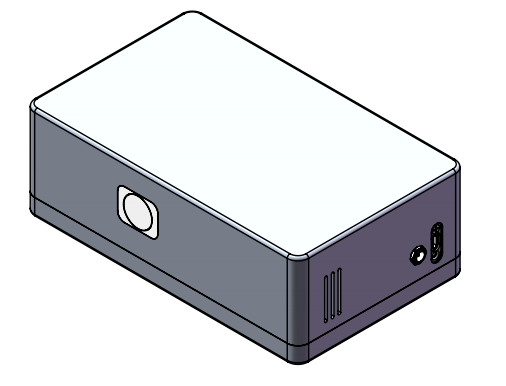
3. Applications
The NIR-S-R16 is aimed at R&D and detection scenarios that require wide-band reflectance information. The 900-2400nm band can simultaneously cover the short-wave NIR and long-wave NIR absorption regions, making it suitable for food, agriculture, materials, pharmaceuticals, chemicals and soil and mineral samples.
It is recommended to keep the loading height, container material, surface condition and pressing conditions consistent across samples. For powdery, granular and non-uniform samples, fix the sampling window, use rotation, or adopt a multi-point acquisition strategy to reduce the impact of local differences on the model.
| Application direction | Description |
|---|---|
| Feed and grain quality | Can cover multiple absorption feature regions such as moisture, protein, fat and starch. |
| Plastic and polymer identification | The wide band can enhance C-H combination absorption and material difference information. |
| Pharmaceutical excipient identification | Suitable for batch consistency analysis of tablets, powders and granular raw and auxiliary materials. |
| Soil and mineral samples | Can be combined with moisture, organic matter and mineral-related features for modeling. |
| Wide-band model research | Suitable for comparing band schemes such as 900-1700nm, 1350-2150nm and 1600-2400nm. |
4. Typical Spectra
The spectra below illustrate the reflectance spectral features or characteristic application regions of common samples within the corresponding band of this model, and do not represent per-unit measured data for this model.
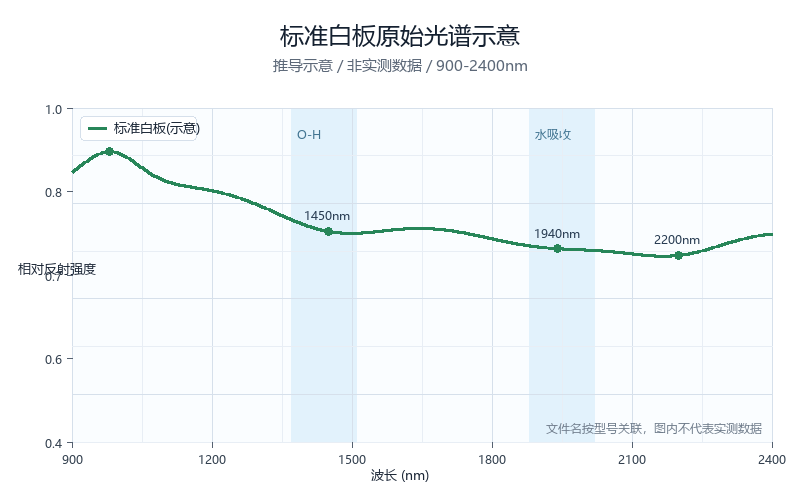
Raw spectrum of a standard white reference
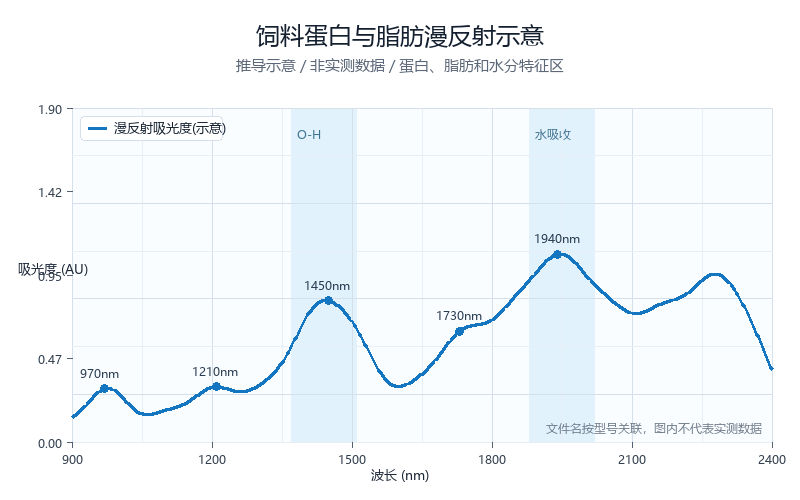
Schematic diffuse reflectance of feed protein and fat
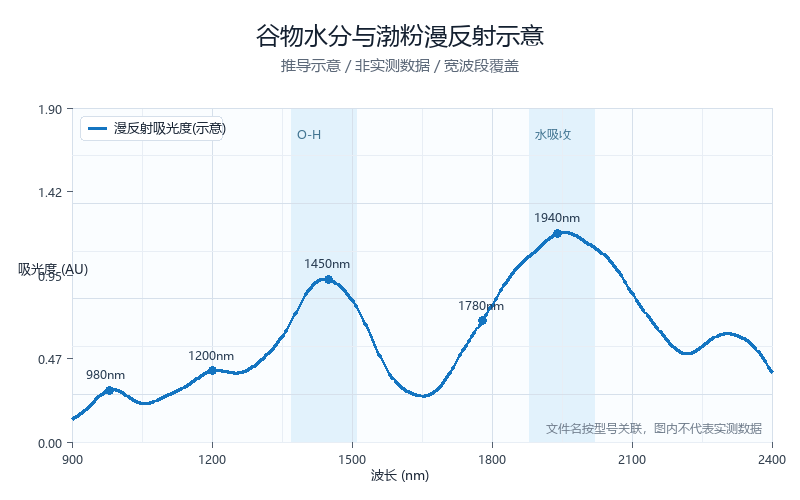
Schematic diffuse reflectance of grain moisture and starch
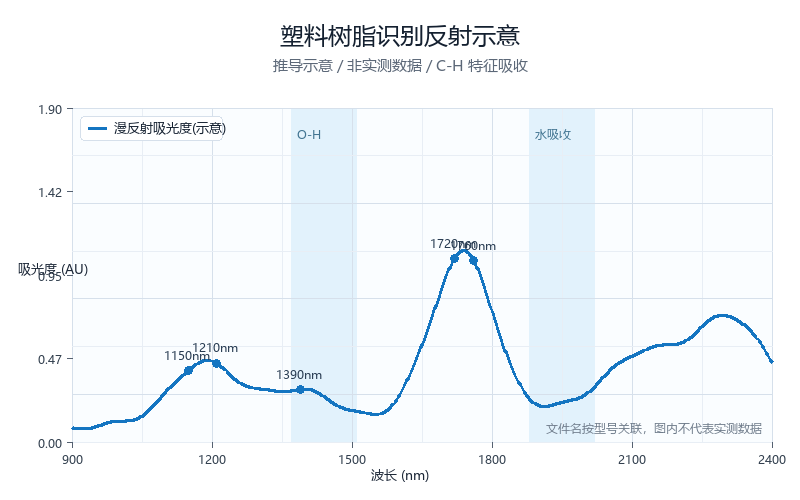
Schematic reflectance of plastic resin identification
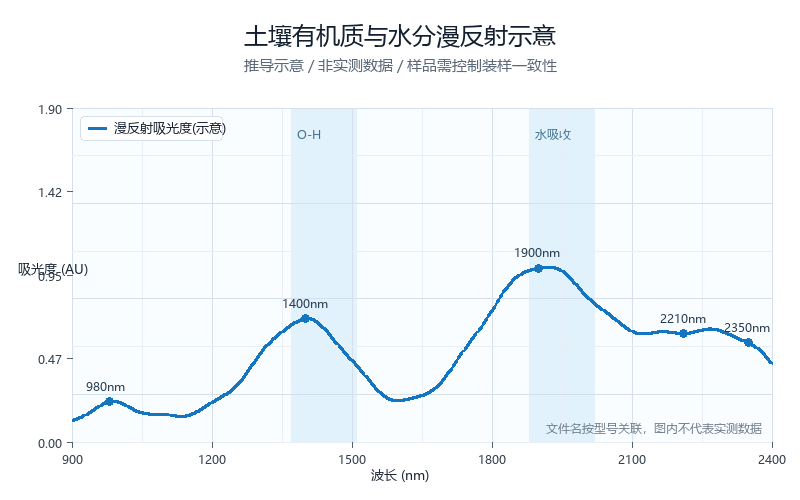
Schematic diffuse reflectance of soil organic matter and moisture
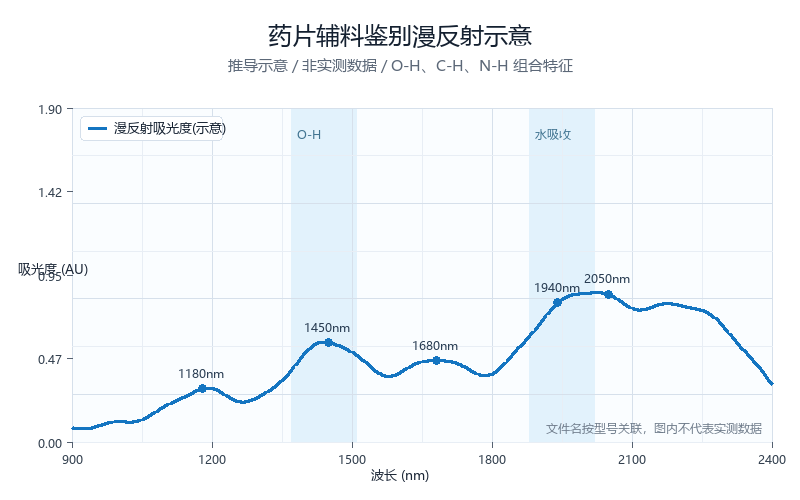
Schematic diffuse reflectance of tablet excipient identification
5. Ordering Information
| Product name | Model | Quantity | Unit price | Amount (CNY) |
|---|---|---|---|---|
| Wide-band reflectance NIR spectrometer | NIR-S-R16 | 1 | Quote by configuration | Quote by configuration |
| Standard reference white plate | STD-DR100 | 1 | 950 | 950 |
| Total | Quote by configuration |
The prices above are for website selection display. Actual quotations are adjusted according to housing, interface, software, accessories, calibration and batch quantity; the formal quotation from sales shall prevail for procurement.
6. Principle
6.1 Chemical Principle
NIR spectroscopy is a form of molecular vibrational spectroscopy. The fundamental vibrations of molecules lie mainly in the mid-infrared region, while overtone and combination transitions fall into the 700-2500nm near-infrared region. This product covers the 900-2400nm band and can capture the characteristic absorption information of hydrogen-containing groups such as O-H, C-H and N-H, making it suitable for qualitative identification, content prediction and process monitoring when combined with chemometric models.
NIR spectra usually do not rely on a single peak; instead, the absorption features of multiple bands are combined for modeling. In practical projects, preprocessing and modeling methods such as smoothing, normalization, SNV, first derivative, second derivative, MSC or PLS are often used to reduce the effects of sample morphology, optical-path differences, scattering and temperature drift.
6.2 Optical Principle
In a reflectance product, the light source, scanning window and receiving optical path are fixed within the whole-unit structure. After the sample is illuminated, it produces a diffuse reflectance signal, which enters the DLP spectral core for wavelength selection and InGaAs detection, making it suitable for non-transparent solids, powders, granules and sheet samples.
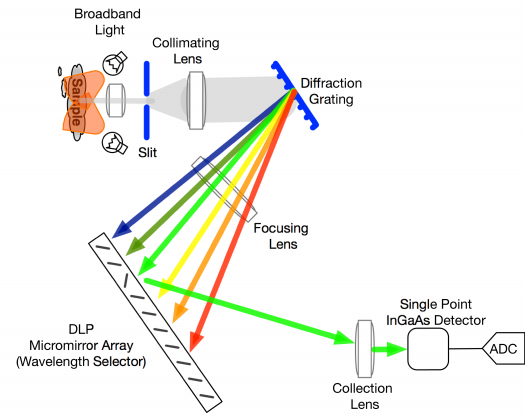
The NIR spectrometer products in this series are based on a DLP spectral architecture and use a grating-dispersion design: light passes through the slit, is collimated, and illuminates the grating; the light of different wavelengths produced after grating dispersion lands side by side on the digital micromirror array (DLP) mirrors; each micromirror is controlled by programming to sequentially reflect the corresponding wavelength to a single-point InGaAs detector, which is then converted into a digital signal by the ADC and resolved into a spectral curve. The schematic diagram is as follows:
6.3 Measurement Principle
A wide-band reflectance whole-unit instrument typically first acquires a reference spectrum from a white plate or standard reference surface, then places the scanning window close to the sample or within the recommended working distance to acquire the sample spectrum, from which the software calculates reflectance or absorbance. Because the window is large and the band is wide, a multi-point measurement and averaging strategy is more suitable for non-uniform samples, improving modeling representativeness.
7. Usage Guide
7.1 Software Usage
- Connect the device using a Type-C cable and a 5V/3A power adapter; warm up the light source before performing white-plate reference and sample acquisition.
- For powder, granular and sheet samples, establish the method using a fixed container, fixed loading thickness and multi-point averaging.
- It is recommended to fix the integration time, averaging count and reference conditions in the bundled software to ensure batch data consistency.
7.2 Precautions
- Keep the sapphire window and standard white plate clean to avoid scratches, dust and fingerprint contamination.
- The recommended working distance is about 2mm, with better sensitivity within 5mm; beyond this, signal attenuation and ambient-light influence increase markedly.
- For highly scattering or obviously textured samples, fix the loading method and repeat acquisition at multiple positions.
- When modeling with wide-band data, it is recommended to combine preprocessing and variable selection to avoid noise introduced by ineffective bands.
7.3 FAQ
Q1: Why is the NIR-S-R16 better suited for modeling complex samples?
A: It covers the 900-2400nm wide band, which can simultaneously include the absorption features of moisture, protein, fat, starch, plastic and many organic components, providing richer information.
Q2: What are the requirements of the large sampling window on the sample?
A: The sample should cover the scanning window as much as possible and keep the surface condition consistent. For granular and powdery samples, it is recommended to unify the loading depth and perform multi-point averaging.