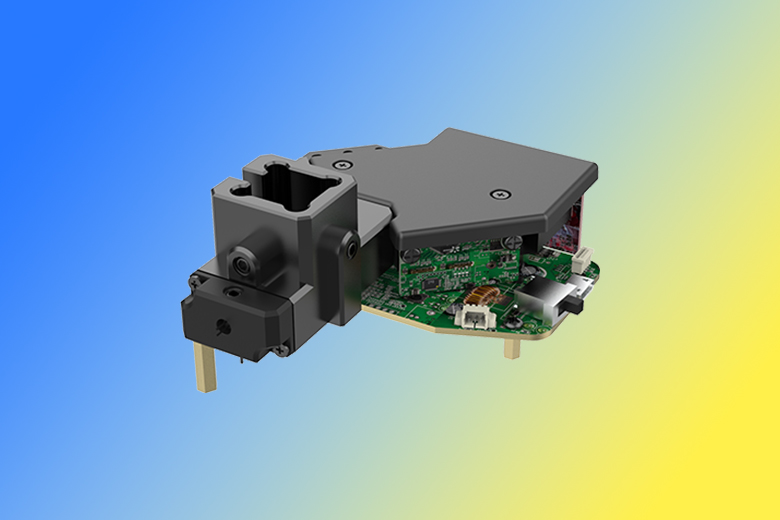
1. Key Features
- Fixed 10mm transmission optical path: built-in NIR light source, collimating optics, 10mm cuvette holder and DLP near-infrared spectral module; insert a standard cuvette to measure transmittance or absorbance directly.
- 900-1700nm wavelength coverage: 1mm InGaAs detector covering the typical NIR absorption features of water, sugars, alcohols, oils and many organic constituents.
- No external optical-path setup: the light source, sample cell and spectrometer are compactly integrated; no external source, fiber or separate cuvette holder is required.
- Ideal for compact instrument integration: small footprint, suitable for embedding in portable liquid analyzers, compact laboratory instruments and automated sampling/analysis equipment.
- Simple reference measurement: use an empty cuvette, pure solvent or blank matrix as the Reference to calculate sample transmittance and absorbance, ideal for building quantitative liquid analysis models.
- Rich interfaces, easy secondary development: supports Micro USB, UART and Bluetooth BLE (optional), with C++, C# and Python SDKs and example programs.
2. Specifications
2.1 Technical Parameters
| Item | Parameter |
|---|---|
| Model | NIR-M-T1 |
| Optical path type | Integrated transmission optical path |
| Wavelength range | 900-1700nm |
| Signal-to-noise ratio (SNR) | 5000:1 |
| Optical resolution | Typ. 10nm |
| Wavelength accuracy | Typ. ±1 nm (verified with RM-NIR) |
| Detector | 1mm standard InGaAs (uncooled) |
| Slit size | 1.8mm × 0.025mm |
| Light source | Built-in 0.7W tungsten lamp |
| Fixed optical path length | 10mm |
| Cuvette holder | Cuvette beam center height Z-dimension = 4.75mm |
| Measurement modes | Transmittance / Absorbance |
| Cuvette type | Standard 10 × 10 mm cuvette, quartz recommended |
| Communication interfaces | Micro USB / UART / Bluetooth BLE (optional) |
| Sensor | Temperature and humidity sensor |
| Power supply | 5V DC. Min. 0.5A DC. |
| Operating temperature | 0-40 °C, RH max. 85% |
| Dimensions | 76mm × 91.8mm × 41.2mm |
| Weight | <106 g |
2.2 Structure and Dimensions
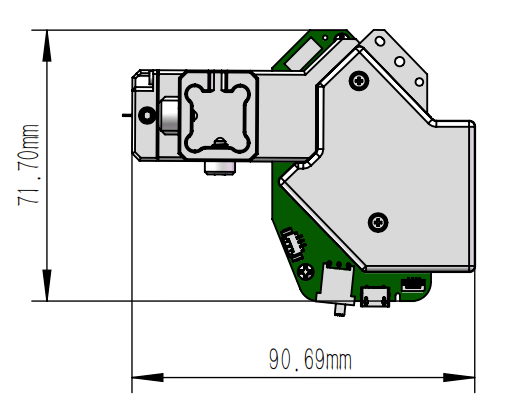
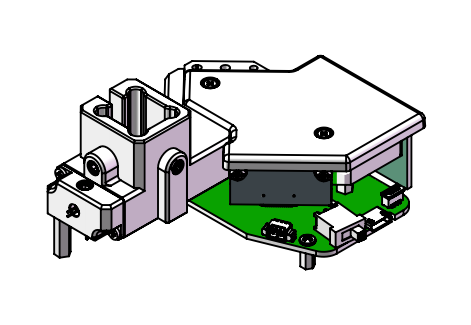
3. Applications
- Solution transmittance measurement: measure the transmittance spectrum of liquid samples over 900-1700nm.
- Solution absorbance analysis: calculate absorbance from a blank reference for concentration modeling and composition analysis.
- Alcohol and solvent testing: analyze the NIR absorption features of ethanol, methanol, organic solvents and mixed solutions.
- Beverage quality analysis: detect sugar content, moisture or formulation differences in beverages, sugar solutions and seasoning liquids.
- Pharmaceutical solution ratio monitoring: check the concentration consistency of clear medicinal liquids, reagent solutions or reaction liquids.
- Fermentation process analysis: track changes in moisture, sugars and alcohols in clarified or pre-treated fermentation broths.
- Compact instrument integration: integrate into portable liquid analyzers or automated sampling and analysis equipment.
4. Typical Optical Path and Spectra
4.1 Typical Optical Path
The NIR-M-T1 uses an integrated cuvette transmission optical path: continuous near-infrared light from the built-in tungsten lamp is collimated and passes through a standard 10mm cuvette, where the sample selectively absorbs different wavelengths; the transmitted light then enters the DLP near-infrared spectral module for dispersion and detection. Users do not need external fibers, a separate light source or a cuvette holder — simply measure the blank reference and the sample in sequence to obtain a transmittance or absorbance spectrum.
A typical measurement workflow:
- Insert a cuvette filled with blank solvent or blank matrix and acquire the Reference as the 100% transmission reference.
- Insert a cuvette filled with the liquid under test and acquire the Sample.
- In routine calculations no separate baseline is acquired; transmittance is computed directly from Sample and Reference, then converted to absorbance.
4.2 Typical Spectra
Transmission near-infrared measurements typically use absorbance spectra as modeling input. For liquid samples, the 900-1700nm band reveals overtone and combination absorption features of hydrogen-containing groups such as O-H, C-H and N-H, and is commonly used for concentration analysis of moisture, alcohols, sugars, oils and organic matter. When building models, it is recommended to preprocess the absorbance spectra with smoothing, normalization, SNV, and first or second derivatives to reduce the influence of source fluctuation, cuvette variation and temperature drift on the model.
Because the NIR-M-T1 uses a fixed, integrated transmission optical path, typical spectra should be based on spectra actually acquired from real samples and blank references. For product demonstrations, use measured absorbance curves of liquid samples such as aqueous ethanol, sugar water, beverages or medicinal liquids; do not substitute spectra from reflectance samples or external optical-path samples.
The images below are illustrative spectra drawn from typical absorption features and do not represent actual measured data for this model. When preparing display spectra of aqueous samples, keep the path length within 2mm to avoid saturation from the strong water absorption above 1400nm at a 10mm path length; non-aqueous samples are labeled with their actual experimental path length.
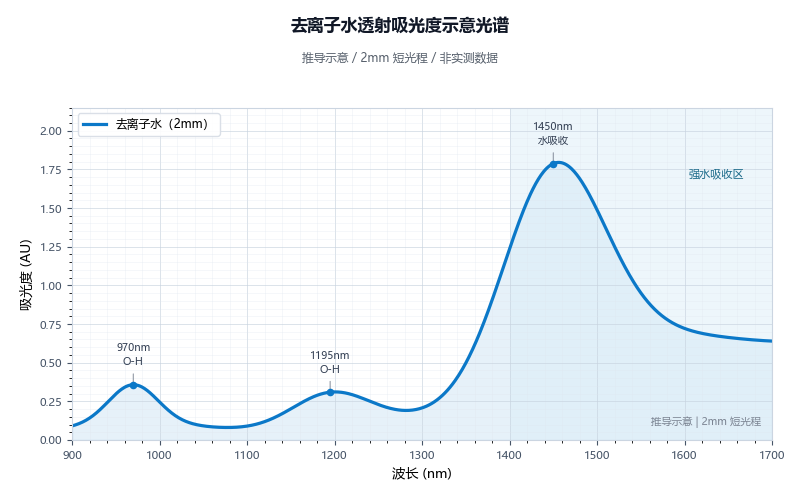
Deionized water transmittance-absorbance illustrative spectrum
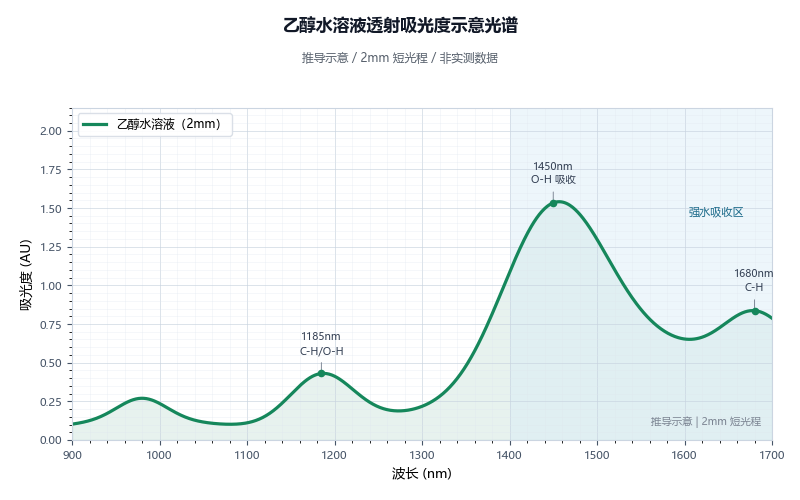
Aqueous ethanol transmittance-absorbance illustrative spectrum
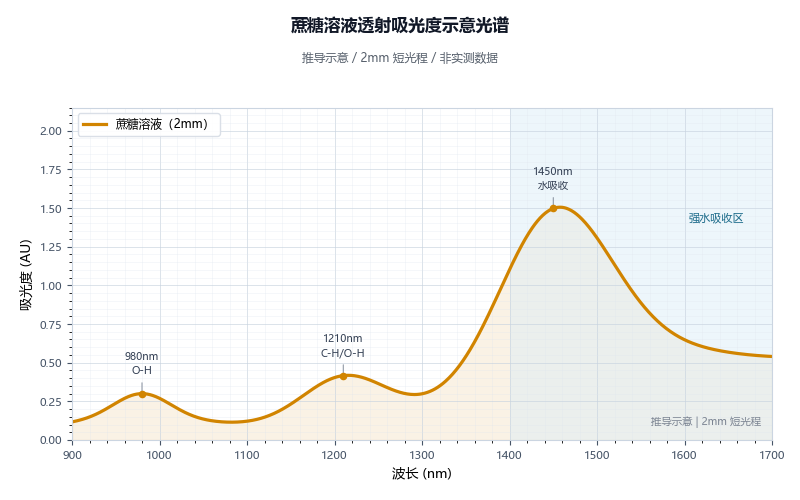
Sucrose solution transmittance-absorbance illustrative spectrum
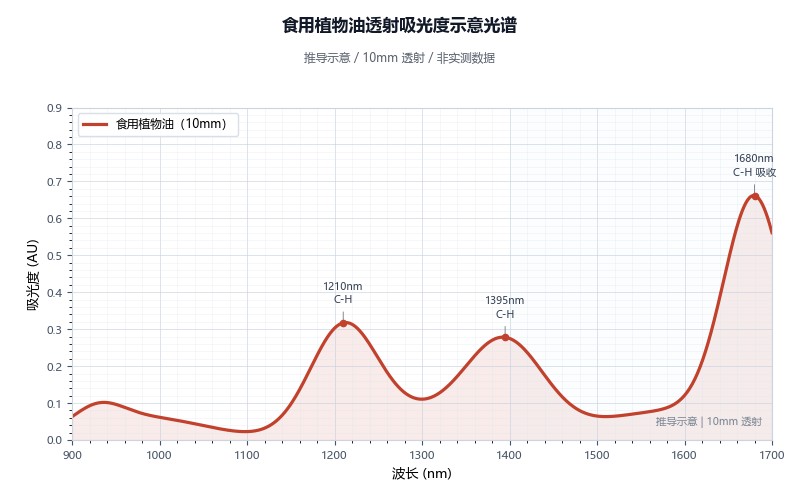
Edible vegetable oil transmittance-absorbance illustrative spectrum
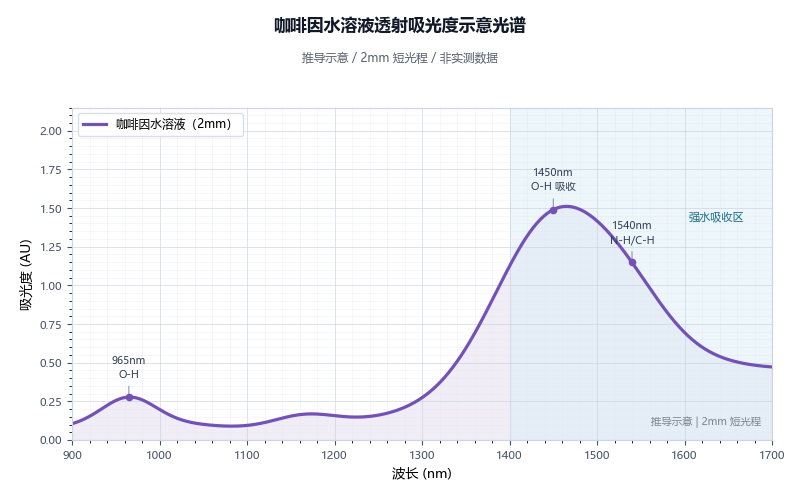
Caffeine aqueous solution transmittance-absorbance illustrative spectrum
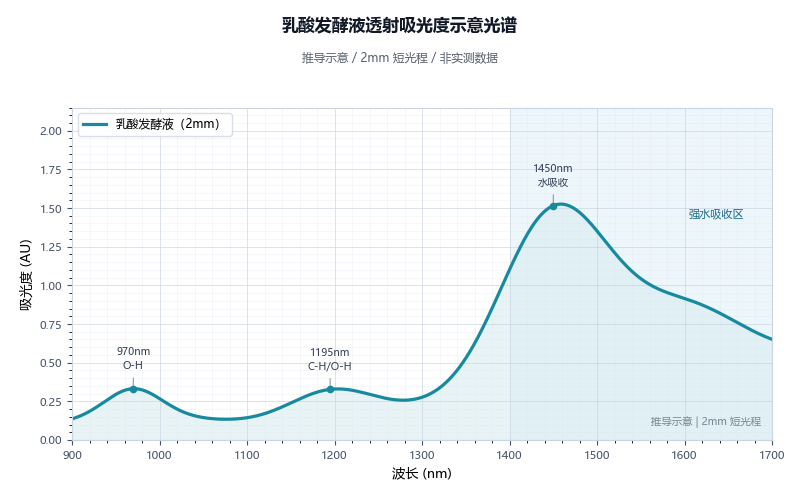
Lactic acid fermentation broth transmittance-absorbance illustrative spectrum
5. Ordering Information
5.1 Bare-Board Module Selection
The NIR-M-T1 is a transmission near-infrared spectral module that integrates the light source, collimating optics and a standard cuvette holder. Routine liquid transmission measurements do not require a standard reflectance white reference; prepare blank solvent, quartz cuvettes and filtration or centrifugation consumables according to your sample system. If the sample absorbs too strongly or is turbid, first reduce saturation and scattering errors through a shorter path length, dilution or sample pretreatment.
| Product name | Model | Qty | Unit price | Amount (CNY) |
|---|---|---|---|---|
| Transmission NIR spectral module | NIR-M-T1 | 1 | 25630 | 25630 |
| Total | 25630 |
5.2 Standard Configuration and Optional Accessories
| Type | Name | Description |
|---|---|---|
| Standard configuration | NIR-M-T1 bare-board module | Includes built-in light source, fixed 10mm cuvette holder and DLP near-infrared spectral module |
| Recommended accessory | Quartz cuvette | Recommended for 900-1700nm NIR transmission measurement |
| Optional accessory | Bluetooth BLE module | For wireless communication and mobile application development |
| Optional accessory | Micro USB adapter cable | Reduces mechanical stress on the bare-board connector from frequent plugging/unplugging |
5.3 Enclosed Instrument Selection
For users who are not integrating the module or only need it for experiments, the enclosed transmission instrument NIR-T210 is recommended. The enclosed version adds a protective housing and USB Type-C adapter on top of the bare-board module, making it better suited to field testing, teaching experiments and mobile application validation.
| Product name | Model | Qty | Unit price | Amount (CNY) |
|---|---|---|---|---|
| Transmission NIR spectrometer | NIR-T210 | 1 | 26950 | 26950 |
| Total | 26950 |
6. Technical Principle
6.1 Chemical Principle
Near-infrared spectroscopy is a form of molecular vibrational spectroscopy. Under near-infrared radiation, molecules in a liquid sample selectively absorb specific wavelengths; the absorption peak positions are determined mainly by the vibrational energy levels of chemical bonds, while the absorption intensity depends on the target-constituent concentration, path length, temperature, hydrogen-bonding state and sample matrix. The NIR-M-T1 uses a 10mm cuvette transmission optical path to directly acquire the sample's transmittance spectrum at a fixed path length, which is then converted to an absorbance spectrum for qualitative identification, concentration prediction and process monitoring.
From a vibrational-energy-level perspective, molecular fundamental vibrations are located mainly in the mid-infrared region, with a wavelength range of about 2.5-25 μm and a wavenumber range of about 4000-400 cm⁻¹. Absorption in the near-infrared region comes mainly from overtone and combination-band transitions of fundamental vibrations, spanning roughly 0.7-2.5 μm, i.e., 700-2500nm. The 900-1700nm range covered by the NIR-M-T1 corresponds to about 11100-5880 cm⁻¹, spanning from the short-wave NIR into the commonly used InGaAs NIR analysis band, and effectively captures the characteristic absorption of hydrogen-containing groups such as O-H, C-H and N-H.
Within this band, the O-H bonds in water and alcohols, the C-H bonds in hydrocarbons and oils, and the N-H bonds in proteins or amines all produce overtone or combination absorption. For example, aqueous systems typically show pronounced O-H-related absorption near 970nm, 1200nm and 1450nm, while C-H-related absorption commonly appears near 1150nm, 1350nm and 1600-1700nm. Because NIR absorption bands are usually broad and overlapping, a single peak seldom corresponds to a single constituent; in practice, analysis therefore does not rely on single-peak interpretation but builds statistical models using full-spectrum or multi-band information.
For transmission measurements, when the sample is homogeneous, the path length is fixed and scattering is weak, absorbance and concentration approximately follow the Lambert-Beer law:
$$A(\lambda) = \varepsilon(\lambda) \cdot b \cdot c$$
where $A(\lambda)$ is the absorbance at wavelength $\lambda$, $\varepsilon(\lambda)$ is the molar absorption coefficient, $b$ is the path length, and $c$ is the concentration of the target constituent. Because NIR bands overlap and matrix and temperature effects are significant, engineering applications usually adopt chemometric methods such as PLS, PCR, PCA and SVM to build calibration models from spectra preprocessed with smoothing, SNV, MSC and derivatives, enabling fast quantitative or qualitative analysis of moisture, alcohol, sugar content, oils, organic-solvent concentration, medicinal-liquid ratio and other indicators.
6.2 Optical Principle
The NIR-M-T1 optical system consists of the built-in tungsten lamp, collimating optics, fixed 10mm cuvette holder and DLP near-infrared spectral module. Continuous near-infrared radiation from the source is collimated and passes through the cuvette sample cell, where the sample selectively absorbs different wavelengths; the transmitted light then enters the spectral module for dispersion and detection. This optical path structurally fixes the relative positions of the source, sample cell and entrance slit, reducing the repeatability errors introduced by external optical-path assembly, fiber coupling and holder alignment.
The spectral module is based on a DLP grating dispersion architecture. Light passes through the slit, is collimated and illuminates the grating (diffraction); after dispersion by the grating, light of different wavelengths lands side by side on the digital micromirror array (DLP). By programming each micromirror, the light of the corresponding wavelength is reflected in sequence onto a single-point InGaAs detector, then converted to a digital signal by the ADC and resolved into a spectral curve. The principle diagram is as follows:
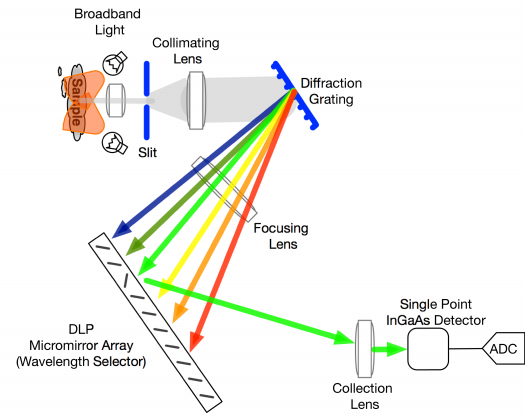
This architecture replaces the traditional linear-array InGaAs detector with a single-point InGaAs detector, reducing system cost while preserving near-infrared spectral acquisition capability. The NIR-M-T1 further integrates the light source, sample cell and spectral module into a fixed transmission optical path, making it suitable for integration into compact liquid NIR detection instruments.
6.3 Measurement Principle
Transmission near-infrared spectrometers mainly measure a sample's spectral transmittance or absorbance. In practice, the blank reference spectrum is acquired first, followed by the sample spectrum. The blank reference can be an empty cuvette, a pure solvent, or a blank liquid matching the sample matrix but without the target constituent.
Transmittance formula:
$$T = \frac{Sample}{Reference}$$
where $T$ is the transmittance, $Sample$ is the sample spectrum, and $Reference$ is the blank reference spectrum.
Absorbance formula:
$$A = -\log_{10}(T) = -\log_{10}\left(\frac{Sample}{Reference}\right)$$
In the routine workflow for this product, baseline noise is simply ignored and no additional baseline processing is required.
7. Usage Guide
7.1 Software Usage
- USB communication: download the latest software from the official website and connect the module to a computer via Micro USB to start spectral acquisition.
- Serial communication: communicate with a host computer, development board or microcontroller over UART, suitable for embedded device integration.
- Bluetooth communication: with the optional Bluetooth BLE module, perform wireless acquisition using mobile software or a self-developed application.
7.2 Precautions
- Use quartz cuvettes with good NIR transmittance; ordinary glass or plastic cuvettes may introduce additional absorption in the NIR band.
- Use cuvettes of the same specification and orientation for Reference and Sample; the liquid level must cover the optical-path window, and avoid bubbles, suspended particles and fingerprint contamination that affect repeatability.
- Warm up for at least 1 minute before measurement and wait until the light source and detector are stable before acquiring reference and sample spectra.
- For strongly absorbing or turbid samples, reduce absorbance saturation and scattering errors by dilution, filtration, centrifugation or switching to a short-path cuvette.
- Re-acquire the Reference after changing solvent, cuvette type or sample system to avoid absorbance offset caused by a mismatched reference.
- After loading the sample, confirm the liquid level fully covers the beam height to avoid low liquid level, attached bubbles or contamination of the cuvette outer wall affecting the measurement.
- Use a Micro USB adapter to connect the module, avoiding damage to the connector pads from repeated plugging/unplugging or uneven force.
- Wear anti-static gloves when handling the bare-board module; never operate it while powered on with sweaty hands.
7.3 FAQ
Q1: What samples can the NIR-M-T1 measure?
A: It mainly suits transparent or translucent liquids, solutions and homogeneous mixtures, as well as samples that can be stably loaded into a 10mm cuvette. Typical samples include aqueous solutions, alcoholic solutions, beverages, medicinal liquids, organic solvents and reaction liquids.
Q2: Is a standard white reference needed for liquid measurement?
A: No. The NIR-M-T1 is a transmission module; the reference spectrum is usually acquired from an empty cuvette, pure solvent or blank matrix, not from the standard white reference used by reflectance modules.
Q3: Why are the absorbance results unstable?
A: Common causes include an insufficiently warmed-up light source, inconsistent cuvette orientation, bubbles or sediment in the liquid, fingerprints on the cuvette outer wall, and large sample-temperature changes. Fix the cuvette orientation, keep the optical-path window clean, and acquire Reference and Sample under the same temperature conditions.
Q4: Can turbid liquids be measured directly?
A: You can attempt measurement, but turbid samples introduce significant scattering, lowering transmittance and causing baseline drift. For quantitative analysis, perform sample pretreatment or build a dedicated calibration model for that sample type.
Q5: Can ordinary glass or plastic cuvettes be used?
A: They can be used for simple functional checks, but are not recommended for NIR quantitative analysis. Ordinary glass or plastic materials may show extra absorption or insufficient transmittance over 900-1700nm; use quartz cuvettes for formal testing.
Q6: What if the sample absorbs too strongly or absorbance saturates?
A: First reduce absorption and scattering effects through pretreatment such as dilution, filtration or centrifugation; if the sample itself absorbs very strongly, re-evaluate the concentration range, reference system and modeling method.