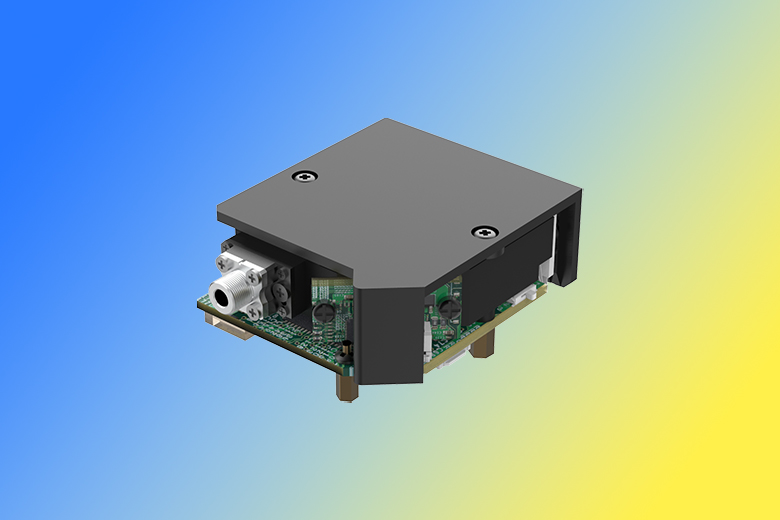
1. Key Features
- Fiber-interface input: Uses an SMA905 fiber interface; pair with reflectance probes, transmission holders, integrating spheres, immersion probes or flow cells as project needs require.
- 1350-2150nm coverage: Suited for hydrogen-containing group absorption analysis and spectral feature acquisition within this band.
- High dynamic range acquisition: The 24-bit ADC and DLP scanning architecture suit weak signals, wide dynamic range and flexible optical-path configuration.
- Flexible communication and integration: Supports USB, UART and optional Bluetooth communication, suitable for PC experiments, embedded systems and mobile-device development.
- SDK secondary development: Provides C++, C#, Python and other interfaces for quick integration into customers' own acquisition and modeling software.
2. Specifications
2.1 Technical Parameters
| Item | Parameter |
|---|---|
| Model | NIR-M-F11 |
| Type | Fiber-coupled NIR spectroscopy module |
| Wavelength range | 1350-2150nm |
| Signal-to-noise ratio | 3000:1 @2000nm |
| Optical resolution | Typ. 12nm |
| Wavelength accuracy | Typ. ±1 nm |
| Detector | 1mm extended InGaAs (uncooled) |
| Slit size | 1.8mm × 0.025mm |
| Fiber interface | SMA905 |
| Communication | Micro USB / UART / Bluetooth BLE (optional) |
| Sensor | Temperature and humidity sensor |
| Power supply | 5V DC, 0.2A DC |
| Operating temperature | 0-40 °C, RH max. 85% |
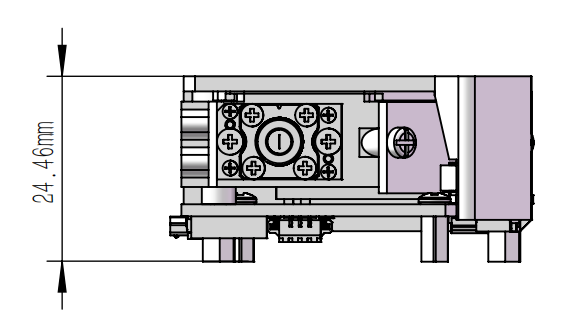
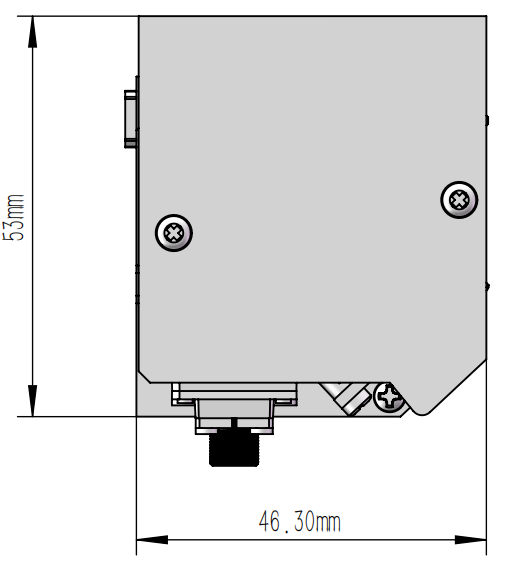
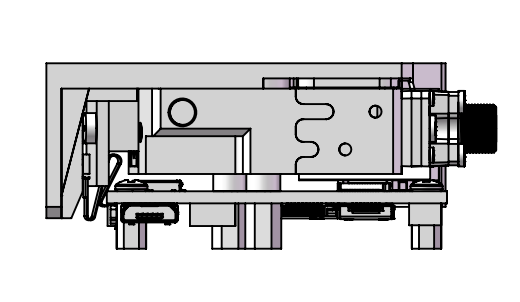
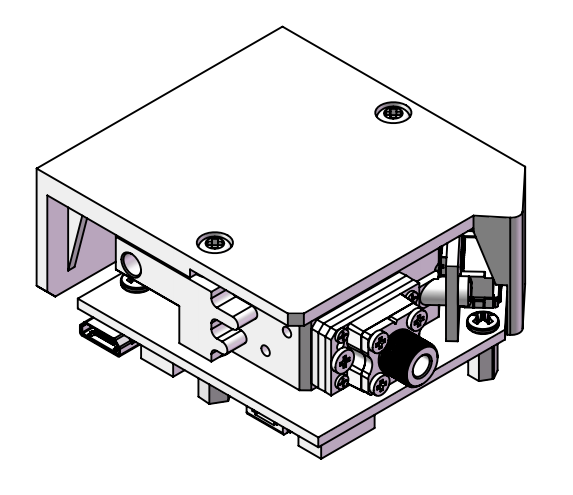
| Dimensions | 48mm × 59.5mm × 24.6mm |
| Weight | < 65g |
2.2 Structure and Dimensions
3. Application Scenarios
The NIR-M-F11 is a fiber-coupled NIR spectroscopy module for users who need to build their own optical paths. It is not limited to a single measurement configuration; transmission, reflection, transflection, integrating-sphere or immersion-probe optical paths can be switched through different accessories, making it suitable for laboratory method development, online test setups, dedicated detection equipment, and teaching and research platforms.
Typical applications include liquid transmission absorbance measurement, transmittance testing of films or lenses, diffuse reflectance measurement of powder and granular samples, measurement of light-source wavelength distribution, and online spectral monitoring in process workflows.
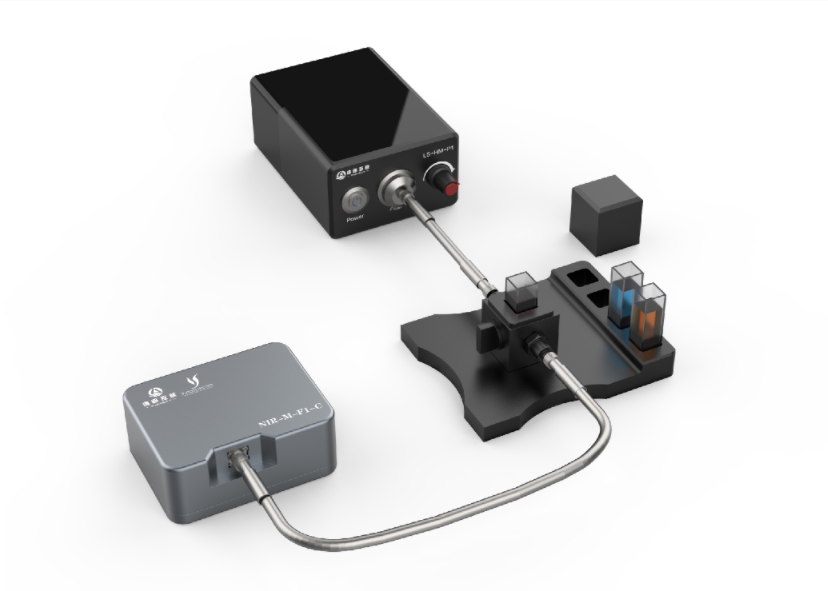
Liquid cuvette-holder transmission path
Measure solution transmittance or absorbance with an external light source and a cuvette holder
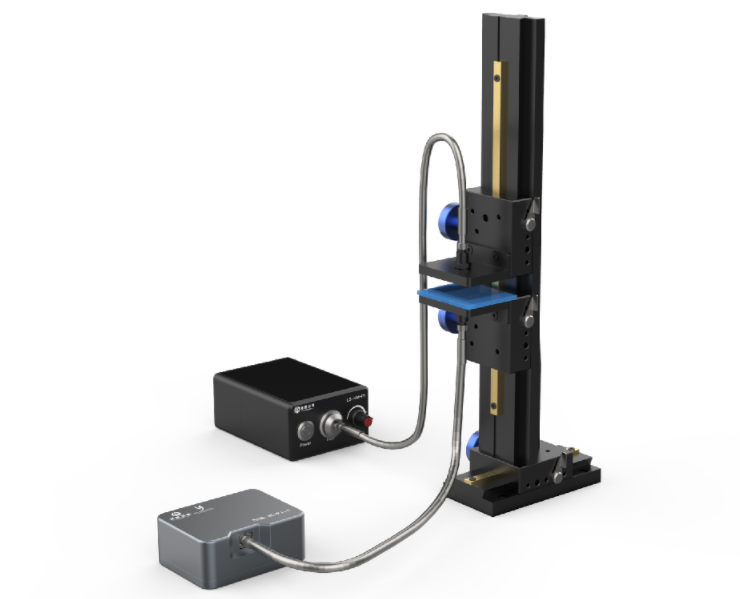
Solid adjustable-gap holder transmission path
For transmittance testing of transparent solids, films, lenses and other materials
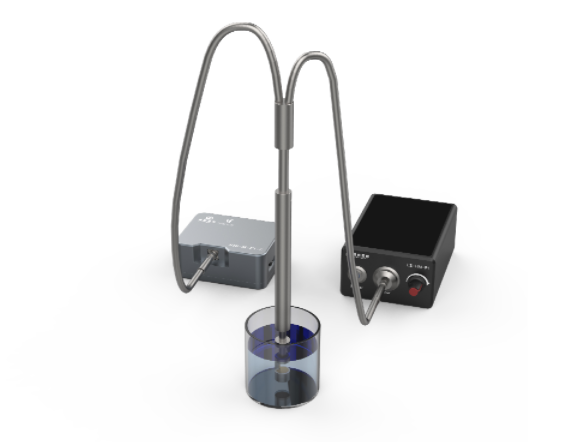
Liquid immersion-probe path
Insert the probe into a liquid or flow cell for online or process monitoring
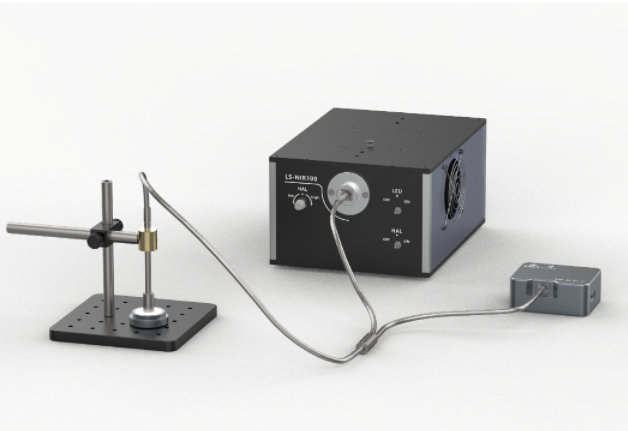
Solid reflectance-probe path
Measure the reflectance spectra of powders, granules, sheets and other samples with a reflectance probe
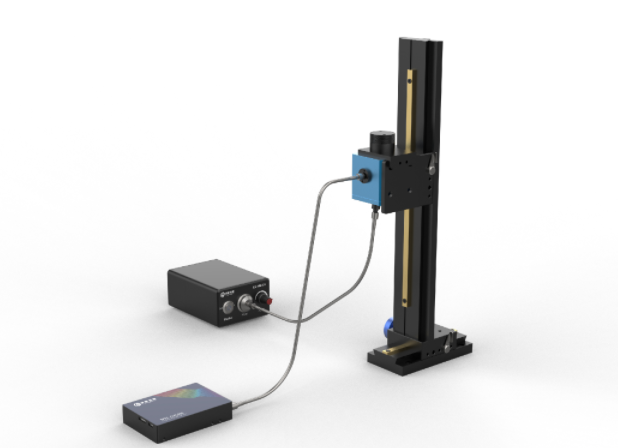
Solid integrating-sphere reflectance path
For samples with strong diffuse reflectance or non-uniform surface conditions
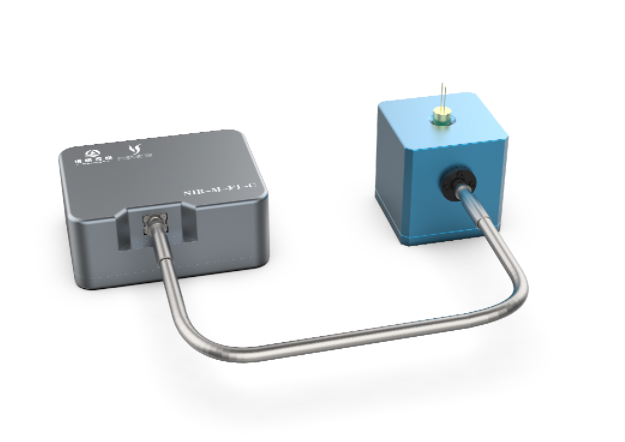
LED wavelength test path
Measure light-source wavelength, peak and FWHM with an integrating sphere or fiber accessory
4. Typical Spectra
The following images are typical representative spectra or application diagrams for the corresponding band, used to illustrate the sample types and characteristic absorption regions this model can cover; they do not represent per-unit measured data for this model. Diagrams of water-containing samples follow the principle of a short optical path within 2mm to avoid saturation in the strong water-absorption region.
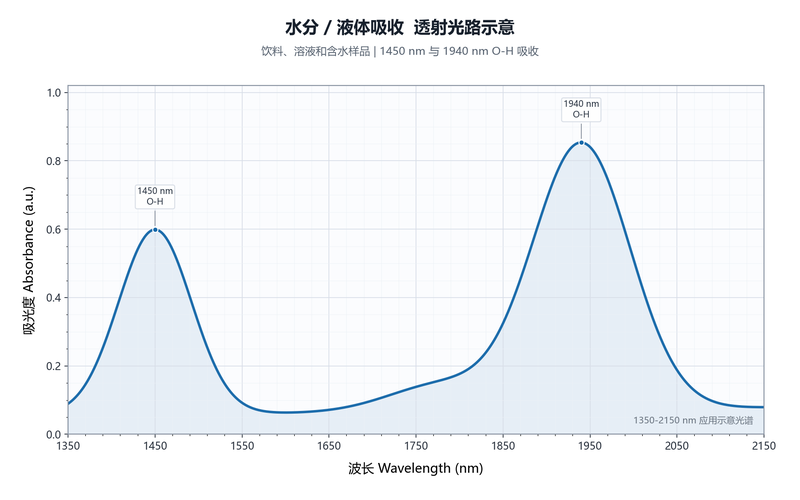
Representative diagram of moisture absorption in liquid
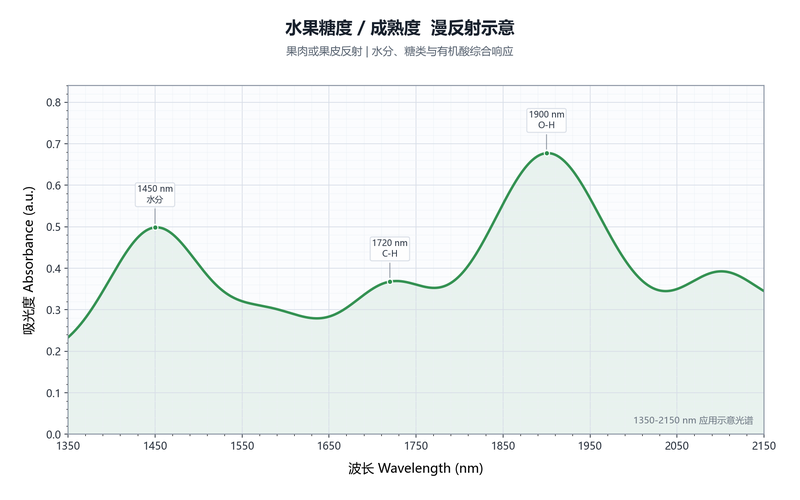
Representative diagram of fruit sugar content and ripeness
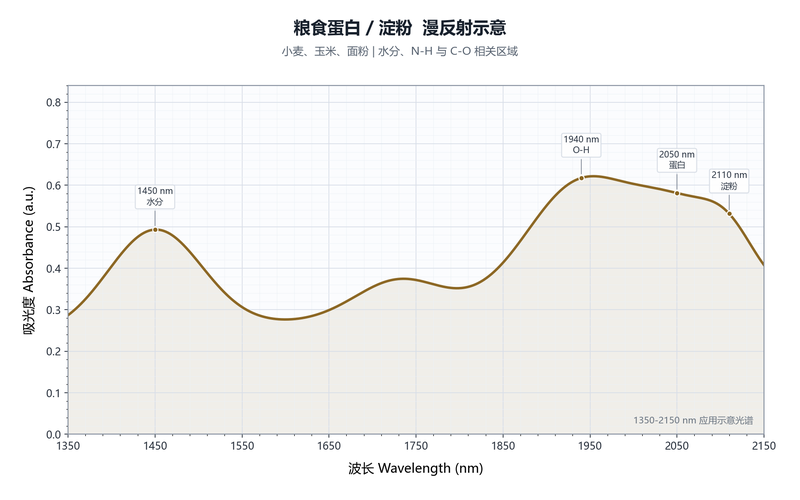
Representative diagram of grain protein and starch
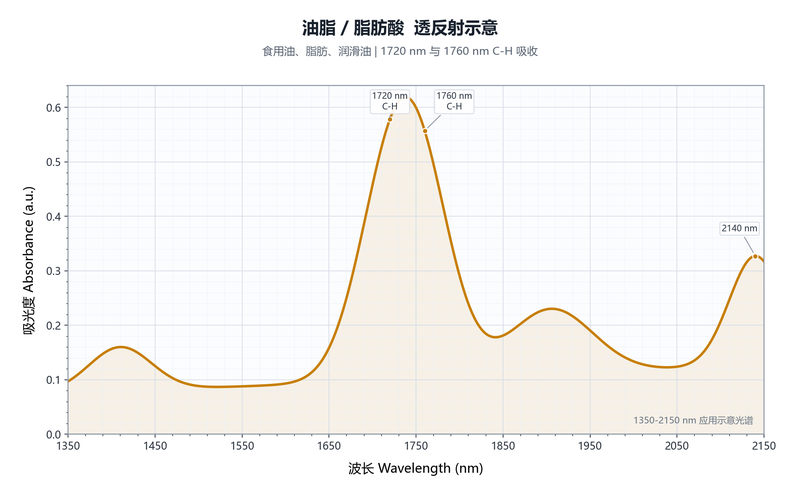
Representative diagram of oils and fatty acids
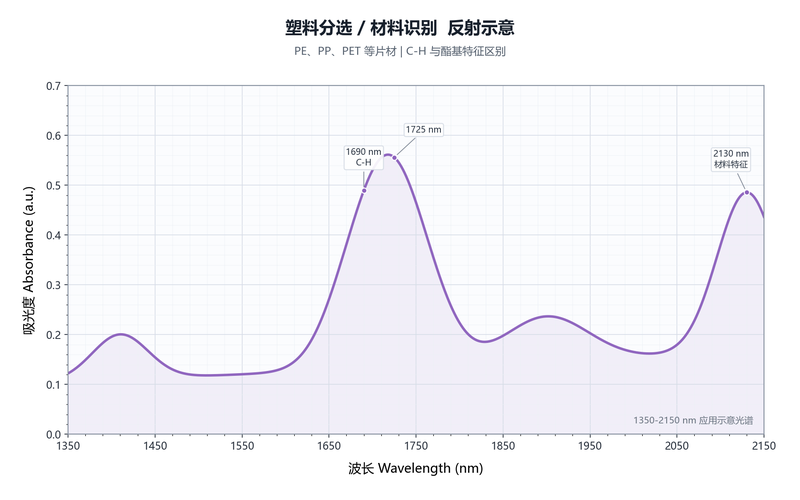
Representative diagram of plastic sorting and material identification
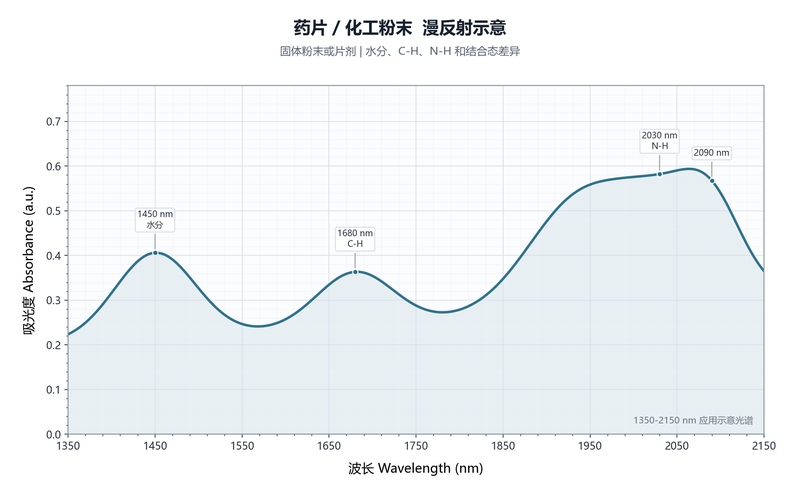
Representative diagram of tablets and chemical powders
5. Ordering Information
5.1 Bare-board Module Selection
| Product | Model | Qty | Unit Price | Amount (CNY) |
|---|---|---|---|---|
| Fiber-coupled NIR spectroscopy module | NIR-M-F11 | 1 | 42350 | 42350 |
| Total | 42350 |
5.2 Enclosed Instrument Selection
For users who only do experimental testing or want to reduce damage to the bare-board interfaces, the corresponding enclosed instrument NIR-F310 is available. The instrument integrates the interfaces, housing and operational protection, making it better suited to repeated plugging/unplugging, field commissioning and customer demonstrations.
| Product | Model | Qty | Unit Price | Amount (CNY) |
|---|---|---|---|---|
| Fiber-coupled NIR spectrometer | NIR-F310 | 1 | 43450 | 43450 |
| Total | 43450 |
6. Technical Principles
6.1 Chemical Principle
Near-infrared spectroscopy is a form of molecular vibrational spectroscopy. Molecular fundamental vibrations lie mainly in the mid-infrared region, while overtone and combination transitions fall in the 700-2500nm near-infrared region. This product covers the 1350-2150nm band and captures the characteristic absorption information of hydrogen-containing groups such as O-H, C-H and N-H, making it suitable for qualitative identification, content prediction and process monitoring combined with chemometric models.
NIR spectra usually do not rely directly on a single peak; instead, models are built by combining absorption features across multiple bands. In practice, preprocessing and modeling methods such as smoothing, normalization, SNV, first derivative, second derivative, MSC or PLS are often applied to reduce the influence of sample form, optical-path differences, scattering and temperature drift.
6.2 Optical Principle
The NIR spectroscopy products in this series are based on a DLP spectral architecture and a grating dispersion design. Light passes through the slit and is collimated before striking the grating (diffraction); the polychromatic light dispersed by the grating lands side by side on the digital micromirror array (DLP). By programming each micromirror, light of the corresponding wavelength is sequentially reflected onto a single-point InGaAs detector, then converted by the ADC into digital signals and resolved into a spectrum. See the schematic below:
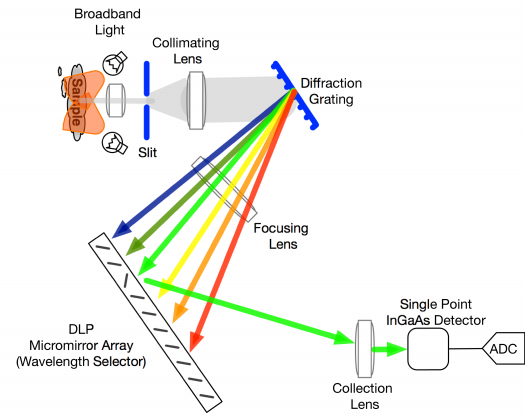
This structure replaces the traditional linear-array detector with a single-point InGaAs detector, reducing system cost while preserving NIR spectral acquisition capability, and is well suited to miniaturization, volume production and embedded integration.
6.3 Measurement Principle
The measurement result of a fiber-coupled product depends on the external optical-path configuration. Transmission measurements typically first acquire a blank reference and then measure the sample spectrum to calculate transmittance or absorbance; reflectance measurements typically use a standard white reference before measuring the sample's reflectance spectrum.
7. Usage Guide
7.1 Software Usage
- USB communication: Connect to a PC and use the bundled software for spectral acquisition, integration-time setting and data export.
- UART communication: Suitable for integration with embedded controllers, MCUs or industrial-control equipment.
- Bluetooth communication: Optional Bluetooth module, suited to mobile or portable device development.
7.2 Precautions
- Keep the fiber end face and accessory windows clean to avoid extra absorption or scattering from fingerprints, dust and scratches.
- Water-containing liquid samples saturate easily in the strong NIR absorption region; use a short-path cuvette, dilute, or reduce the effective optical path.
- Reflectance measurements require a stable reference white standard and repeatable probe contact conditions.
- Before each formal acquisition, warm up the light source and fix the integration time, number of averages and dark-background processing method.
7.3 FAQ
Q1: Can the NIR-M-F11 measure liquids directly?
A: It is itself a fiber-input module; liquid transmission measurement requires an external light source, fiber and a cuvette holder or flow cell.
Q2: How do I choose between a fiber-coupled module and an integrated reflectance/transmission module?
A: If you need flexible optical-path building, accessory switching or method development, choose the fiber-coupled type first; if the target application is already defined and you need compact integration, choose an integrated reflectance or transmission module.