Overview
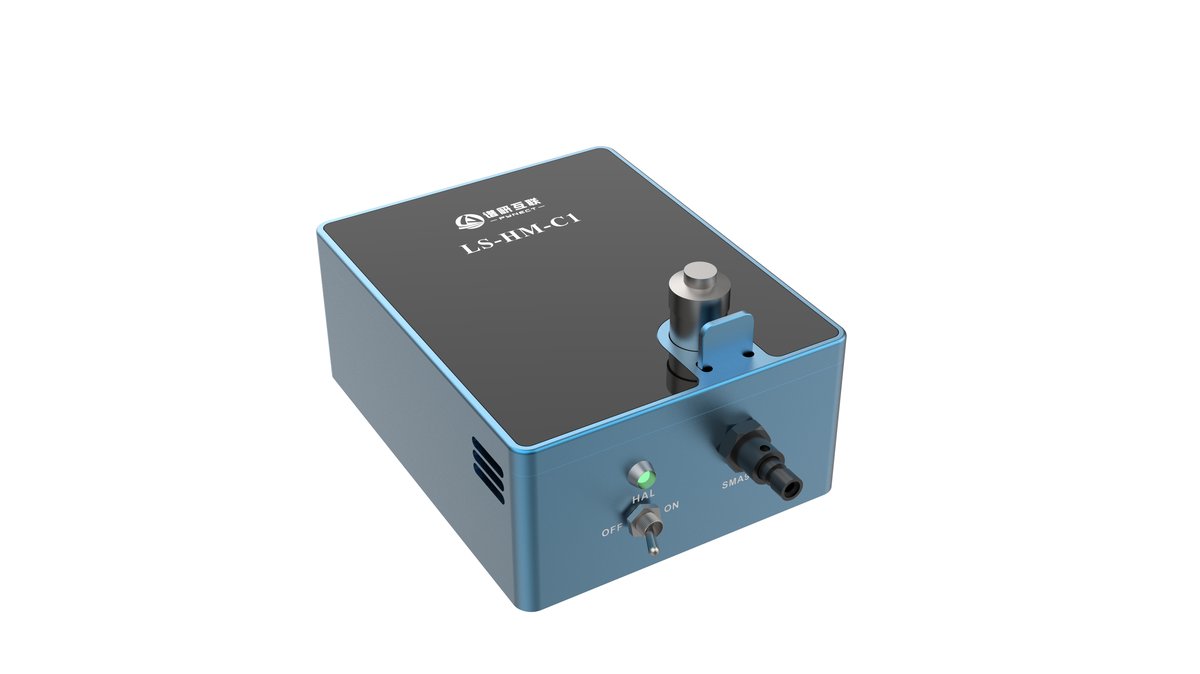
The LS-HM-C1 is a 10W general-purpose tungsten light source featuring an American IntllightTech high-purity xenon-protected bulb with constant-current drive. Instant-on stability without warm-up, micrometer precision attenuation and 350-3000nm continuous spectral coverage make it the most commonly paired light source for laboratory fiber-optic spectroscopy systems, balancing intensity, stability and ease of use.
1. Key Features
- Precision constant-current drive for long-term stability: The constant-current source locks filament current against ambient temperature and power-line fluctuations, ideal for long continuous acquisition.
- Adjustable intensity via precision mechanical attenuation: The micrometer adjusts output without changing filament operating conditions, so color temperature and spectral distribution stay constant across intensity levels.
- Professional optics, focused coupling: The IntllightTech bulb has a built-in lens; with secondary collimation, 10W input achieves throughput exceeding a 100W pin-type bulb - high efficiency, low heat.
- High-purity xenon protection for longer life: >2000 h at 10W high-brightness mode; >10,000 h at 5W long-life mode.
- Instant-on, no warm-up: Constant-current drive reaches stable output immediately after power-on.
2. Specifications
| Item | Parameter | Notes |
|---|---|---|
| Model | LS-HM-C1 | |
| Wavelength range | 350-3000nm | Visible to NIR |
| Rated power | 10W (5W long-life mode selectable) | |
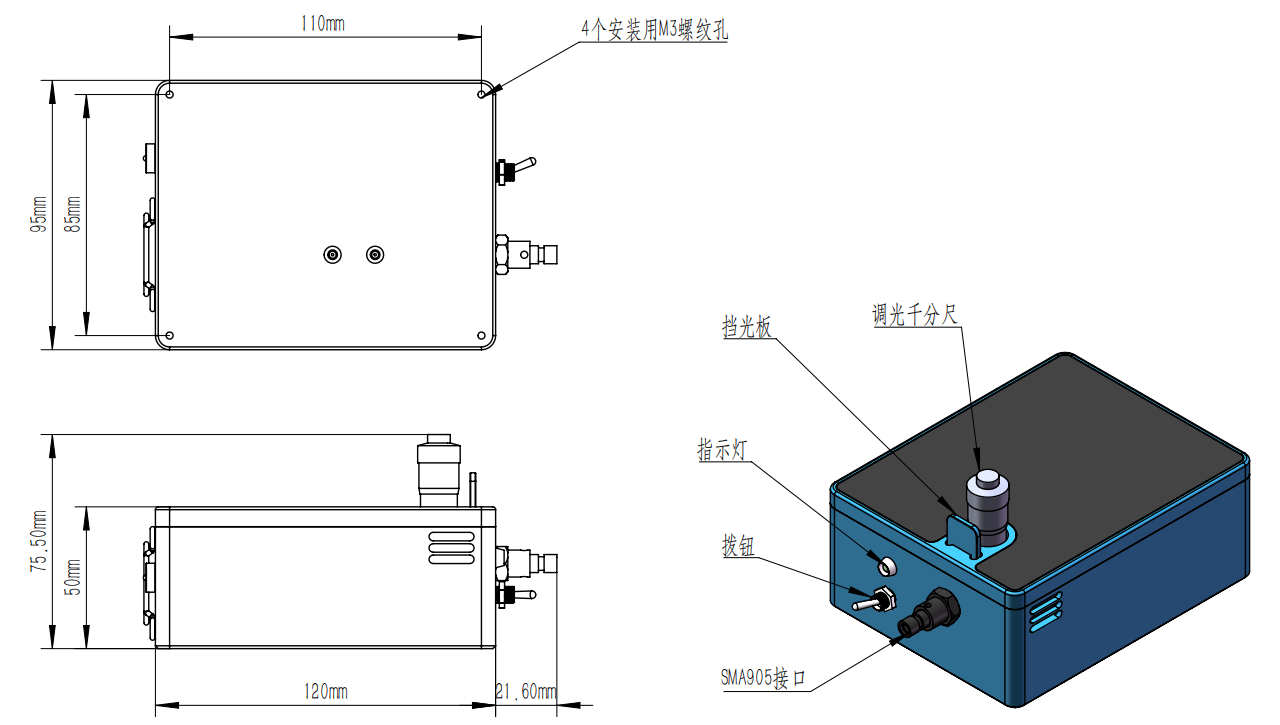
| Optical interface | SMA905 | Industry standard |
| Adjustable intensity | Yes | Micrometer precision |
| Dark background | Supported | Dark shutter |
| Bulb lifetime | >2000 h @10W, >10000 h @5W | |
| Power supply | 12V/2A |
3. Appearance
4. Working Principle
4.1 Continuous spectrum of tungsten-halogen lamps
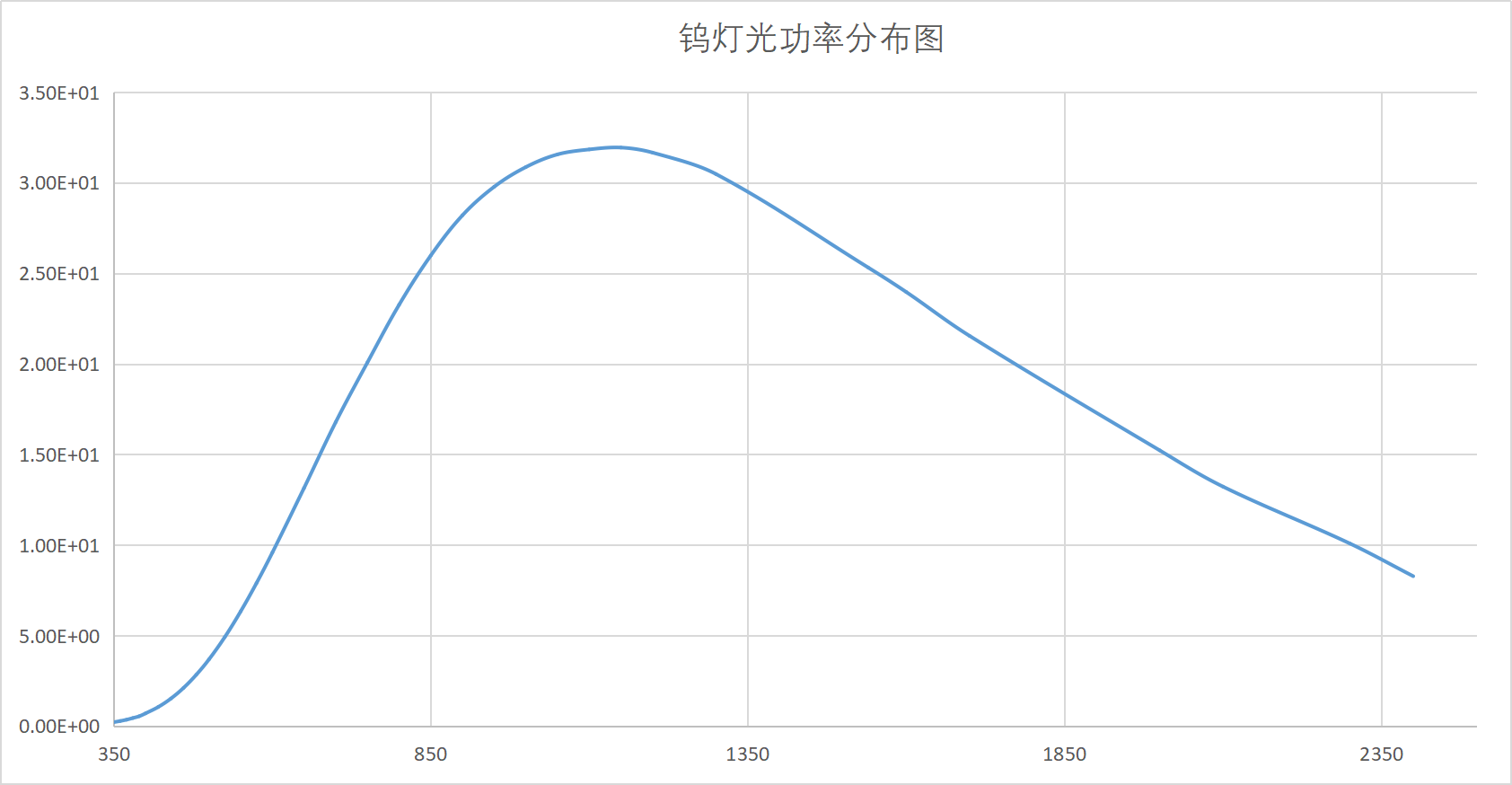
The filament emits a smooth, line-free 350-3000nm continuous spectrum, ideal as a broadband source for transmittance, reflectance and absorbance measurements. The spectral peak lies in the NIR; visible intensity decreases toward shorter wavelengths, which is why dark-background and white-reference correction are standard practice.
4.2 Constant-current drive and stability
Filament resistance changes with temperature; under constant-voltage drive, grid and ambient fluctuations cause current and intensity drift. The LS-HM-C1 constant-current source locks filament current, making output insensitive to temperature and voltage changes and keeping the spectral baseline flat over long acquisitions.
4.3 How micrometer attenuation works
A precision screw moves a shutter to change the aperture, giving continuously adjustable output. Because filament current never changes, color temperature and spectral distribution are identical at every intensity level, preserving comparability across measurements.
5. Common Setups
| Setup | Typical configuration | Main use |
|---|---|---|
| Cuvette holder | Light source + cuvette holder + fiber | Solution transmittance/absorbance per standard spectrophotometry |
| Online liquid | Light source + flow cuvette holder | Online transmittance of reaction liquids |
| Immersion probe | Light source + immersion transmission probe | In-solution measurement |
| Solid transmittance | Light source + transmission holder | Lens, film and plastic transmittance |
| Solid reflectance | Light source + reflectance integrating sphere | Surface reflectance of solids or powders |
6. Setup and Measurement Steps
Solid transmittance example:
- Connect the LS-HM-C1 to a 12V/2A supply; output is stable immediately, no warm-up.
- Connect the source to the transmission holder input with an SMA905 fiber; connect the output to the fiber spectrometer.
- In SmartSoft, set integration time and averaging; acquire dark background first.
- Acquire a white reference without a sample, then insert the sample; the software computes the transmittance curve automatically.
- Adjust intensity slowly with the micrometer and watch for detector saturation.
7. Applications
- Routine laboratory spectroscopy as the companion source for fiber spectrometers.
- Solution analysis: concentration, turbidity and COD via cuvette setups.
- Transmittance QC: lenses, filters and packaging films.
- Reflectance measurement: coatings, paper and fabrics with integrating spheres or probes.
- Teaching: standard source for spectroscopy and photometry experiments.
The LS-HM-C1 covers most laboratory scenarios and switches measurement modes quickly with different accessories - one of the most versatile sources in the lineup.
8. Spectrometer Pairing
| Spectrometer | Band match | Recommended measurements |
|---|---|---|
| SPEC-CMS960 (190-1100nm) | Full visible | Transmittance, absorbance, reflectance |
| SPEC-CDS350 (190-1100nm) | Full visible | Solution analysis, color measurement |
| NIR-F950 / NIR series | NIR | NIR transmittance measurement |
At 10W the signal is strong without saturation for the spectrometers above - the most common "source + spectrometer" lab combination. The instant-on design suits multi-batch continuous measurement.
9. FAQ
Q: Is it really usable immediately at power-on?
A: Yes. Constant-current drive reaches rated filament current instantly; intensity and color temperature are stable with no warm-up.
Q: How do I choose between 5W long-life and 10W high-brightness modes?
A: Use 10W for routine work; switch to 5W for unattended or 7x24 online operation - bulb life exceeds 10,000 hours.
Q: How repeatable is micrometer attenuation?
A: The precision screw mechanism reproduces positions exactly; scale readings let you return to the same intensity setting.
Q: How do I use the dark shutter?
A: Flip the shutter over the output port when acquiring dark spectra; no need to power off or unplug fibers.
Q: How long can it run continuously?
A: Hours at 10W; the 5W mode is designed for 7x24 continuous operation with >10,000-hour bulb life.
Q: Does it need regular cleaning?
A: Clean the SMA905 port and fiber end faces periodically; no routine maintenance is needed inside the housing.
Q: Why does constant-current drive improve stability?
A: Filament resistance varies with temperature, so constant-voltage drive lets current drift. Locking the current makes intensity depend only on the filament thermal equilibrium, insensitive to environment and grid fluctuations.
Q: Can it feed multiple spectrometers at once?
A: Yes, via fiber splitters, but expect lower per-channel intensity - increase integration time accordingly.
10. Selection Guide
The LS-HM-C1 (10W) sits mid-range: unlike the LS-H100 (100W) it needs no warm-up and uses simple 12V power; compared with the LS-HM-P3 (2.5W) it delivers higher intensity for SNR-critical transmittance work.
| Item | LS-H100 | LS-HM-C1 | LS-HM-P3 |
|---|---|---|---|
| Bulb power | 100W | 10W | 2.5W |
| Attenuation | Iris | Micrometer | Micrometer |
| Warm-up | 15 min | Instant | Instant |
| Power supply | 220V | 12V/2A | 12V/1A |
| Long-life mode | None | 5W / 10,000 h | 1.2W / 100,000 h |
11. Precautions
- Use the supplied 12V/2A adapter; avoid unstable power sources.
- Set intensity low before connecting fibers to prevent detector saturation.
- Use the 5W long-life mode for unattended operation.
- Confirm shutter position before dark-spectrum acquisition.
- Power off and allow cooling before bulb replacement; contact the manufacturer for genuine bulbs.
12. Package Contents and After-Sales
Package: LS-HM-C1 unit, 12V/2A adapter, SMA905 fiber patch cord, user manual, warranty card.
After-sales: one-year whole-unit warranty; bulbs are consumables covered by actual service life. Lifetime technical support and selection consultation with 7x24 response.
13. Ordering
- Product: LS-HM-C1 Tungsten Light Source
- Series: Spectroscopy Light Sources
- Technical: Formulas for Common Spectral Measurement Modes
For sample trials or bulk purchases, please contact us.