Overview
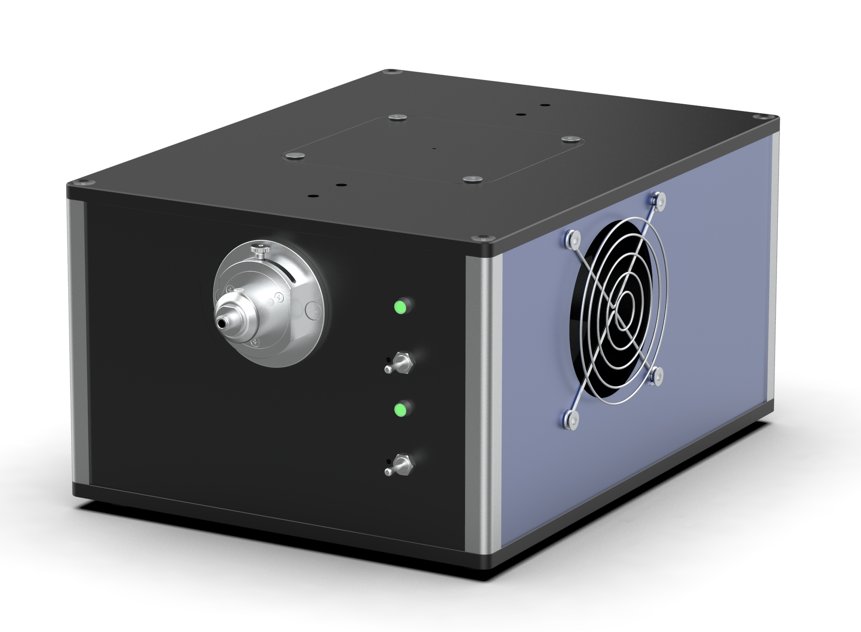
The LS-H100 is a 100W high-power tungsten light source for laboratory and industrial testing. It combines a German Osram halogen bulb with LED UV compensation, precision iris attenuation and dual silent fans, delivering high-brightness, high-stability continuous illumination across 380-3000nm. It is the first choice for high-intensity transmittance, reflectance, absorbance and color measurement setups.
1. Key Features
- 100W high power: A German Osram 100W halogen bulb with collimating and focusing lens groups couples light into the fiber for large throughput, ideal for high-SNR transmittance, reflectance and absorbance measurements.
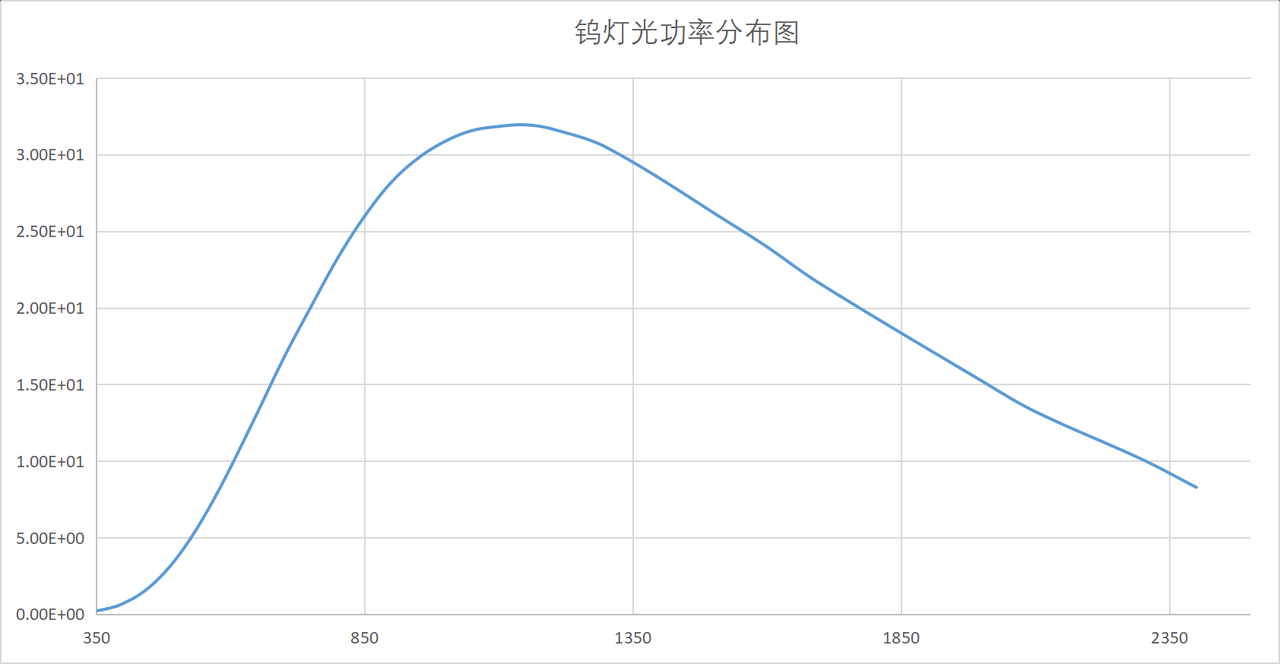
- LED UV compensation: Tungsten-halogen output is weak in the 380-420nm range; the built-in LED compensation fills this gap for a more balanced 380-3000nm spectrum.
- Iris precision attenuation: The iris adjusts output without changing filament current, so color temperature and spectral distribution stay constant across intensity levels.
- Long life, high stability: The bulb is filled with high-purity xenon and coated with an IR-reflecting coating for higher efficiency and up to 2000-hour lifetime.
- Dual silent symmetric fans: Symmetric dual-fan cooling keeps the lamp housing at constant temperature for stable color temperature output.
- Professional optical design: Focusing lens groups maximize coupling efficiency into the standard SMA905 fiber interface.
2. Specifications
| Item | Parameter | Notes |
|---|---|---|
| Model | LS-H100 | |
| Wavelength range | 380-3000nm | Visible to NIR |
| Rated power | 100W | High stability |
| Optical interface | SMA905 | Industry standard |
| Adjustable intensity | Yes | Precision iris |
| Warm-up time | 15 min | Recommended before measurement |
| Bulb lifetime | 2000 h | |
| Power supply | 220V | |
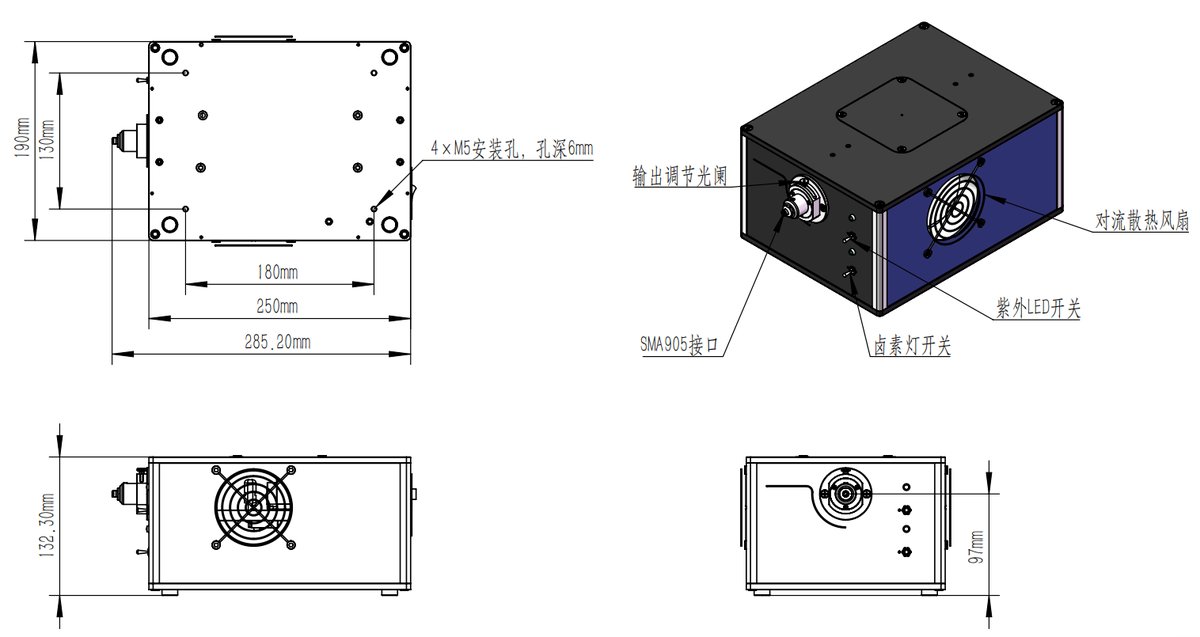
| Dimensions / weight | 190 x 250 x 130 mm; 495 g |
3. Appearance
4. Working Principle
4.1 Tungsten-halogen emission
Tungsten-halogen lamps are thermal radiators: the filament emits a continuous blackbody-like spectrum at roughly 3000K color temperature. Unlike gas-discharge lamps, the spectrum is smooth and free of characteristic lines across the visible and NIR, making it the standard broadband source for spectroscopy. The halogen cycle redeposits evaporated tungsten onto the filament, extending bulb life.
4.2 Why iris attenuation?
Common dimming methods vary filament current or voltage, which shifts filament temperature, color temperature and spectral distribution, hurting repeatability. The LS-H100 uses mechanical iris attenuation: the filament always runs at rated conditions, so color temperature and spectral shape stay constant; only the aperture changes output intensity.
4.3 The role of LED UV compensation
Tungsten-halogen radiant intensity below 380-420nm is very low, and measurements in this band suffer from high noise. The built-in LED UV compensation restores short-wave visible output, reliably supporting measurements starting at 380nm.
5. Common Setups
| Setup | Typical configuration | Main use |
|---|---|---|
| Cuvette holder | Light source + cuvette holder + fiber | Solution transmittance/absorbance per standard spectrophotometry |
| Online liquid | Light source + flow cuvette holder | Online transmittance or absorbance monitoring |
| Immersion probe | Light source + immersion transmission probe | In-solution measurement |
| Solid transmittance | Light source + transmission holder | Lens coating, plastic, ink transmittance |
| Solid reflectance | Light source + reflectance integrating sphere | Surface reflectance of solids or powders |
6. Setup and Measurement Steps
Solution absorbance example:
- Connect the LS-H100 to 220V and warm up for 15 minutes.
- Connect the source to the cuvette holder input with an SMA905 fiber; connect the holder output to the fiber spectrometer.
- In SmartSoft, set integration time so the signal peak reaches 70%-90% of full scale; acquire dark background and blank reference.
- Insert the sample solution and acquire its spectrum; the software computes transmittance and absorbance curves automatically.
- After measurement, close the iris before powering off to protect the detector from strong light.
For solid reflectance, replace the cuvette holder with a reflectance integrating sphere and use a standard white reference.
7. Applications
- Quantitative solution analysis: build concentration-absorbance curves via the Lambert-Beer law.
- Optical component testing: transmittance of filters, coated lenses and ITO glass.
- Color and appearance: surface reflectance spectra and chromaticity via reflectance probes.
- Transmissive material QC: plastic, ink and paper transmission uniformity.
- Research and teaching: standard continuous source for spectroscopy experiments.
8. Spectrometer Pairing
| Spectrometer | Band match | Recommended measurements |
|---|---|---|
| SPEC-CMS960 (190-1100nm) | Full visible | Transmittance, absorbance, reflectance |
| SPEC-CDS350 (190-1100nm) | Full visible | Solution analysis, color measurement |
| NIR-F950 / NIR series | NIR | NIR transmittance measurement |
With SmartSoft, dark background, white reference, transmittance and reflectance workflows run automatically; the PynectDirect SDK enables custom automation.
9. FAQ
Q: Why warm up for 15 minutes?
A: The 100W bulb has large thermal inertia; intensity and color temperature drift slightly after power-on. After warm-up the output stabilizes and measurements are more repeatable.
Q: Does LED UV compensation change color temperature?
A: No. It only supplements the 380-420nm band; the filament always runs at rated conditions.
Q: Can I use it for UV measurements?
A: Coverage starts at 380nm, so deep-UV capability is limited; use the LS-XE-FH xenon flash lamp for deep UV.
Q: Is fan noise an issue?
A: Dual silent symmetric fans are lab-friendly. For fully silent operation, consider the fanless LS-HM series.
Q: What is the difference between iris and micrometer attenuation?
A: The principle is identical - mechanical blocking changes output without altering filament state. The LS-H100 iris suits the 100W lamp housing with travel and cooling optimized for high power.
Q: Can it run continuously?
A: Yes. Dual-fan cooling keeps the housing at constant temperature; continuous operation for hours is fine for batch and online measurement.
10. Selection Guide
| Item | LS-H100 | LS-HM-C1 | LS-HM-P3 |
|---|---|---|---|
| Bulb power | 100W | 10W | 2.5W |
| Wavelength range | 380-3000nm | 350-3000nm | 350-3000nm |
| Attenuation | Iris | Micrometer | Micrometer |
| Warm-up | 15 min | Instant | Instant |
| Power supply | 220V | 12V/2A | 12V/1A |
- Maximum intensity with UV compensation: LS-H100.
- General lab use with instant-on convenience: LS-HM-C1.
- Portable integration with low power and long life: LS-HM-P3.
11. Precautions
- Warm up for 15 minutes before formal measurement.
- Use the supplied 220V power cable; avoid sharing outlets with other high-power devices.
- Keep fan intakes clear and leave cooling space around the housing.
- Operate the iris slowly and avoid contact with live parts.