1. Key Features
- 190-1100nm broadband coverage: Spans UV, visible and short-wave NIR for light source spectra, color, transmittance, reflectance, absorbance and fluorescence measurements.
- High-sensitivity professional optics: Built-in order-sorting filter and enhanced cylindrical lens reduce higher-order diffraction and improve weak-light response.
- 2048-pixel Hamamatsu detector: Hamamatsu S11637-2048Q for high-sampling-point spectral distribution measurement.
- Highly stable circuit design: Feedback, filtering, signal-integrity and EMI-resistant design reduces non-detector electronic noise - suited for long-term online acquisition.
- Multiple interfaces and industrial protocols: Type-C, RS232 and RS485 with optional USB standard, USB extended and Modbus protocols for lab and industrial integration.
- Built-in temperature monitoring and drift compensation: Onboard temperature sensor and drift compensation improve long-duration measurement consistency.
2. Specifications
2.1 Technical Parameters
| Item | Parameter |
|---|---|
| Model | SPEC-CMS960 |
| Type | Broadband high-sensitivity professional fiber spectrometer |
| Wavelength range | 190-1100nm (default, configurable) |
| Optical resolution | 0.3-3.2nm (configuration dependent) |
| Wavelength accuracy | Typ. +/-0.01nm |
| Signal-to-noise ratio | 350:1 |
| Slit size | 50μm default; 10μm, 25μm, 100μm, 200μm optional |
| Detector | Hamamatsu S11637-2048Q |
| Optical interface | SMA905 |
| Communication | Type-C / RS232 / RS485 |
| Protocols | USB standard / USB extended / Modbus (serial) optional |
| Built-in sensor | Temperature sensor |
| Drift compensation | Built-in |
| Power | 5V / 0.3A |
| Dimensions | 105mm x 68mm x 23mm |
| Weight | Approx. 230g |
2.2 Appearance and Dimensions
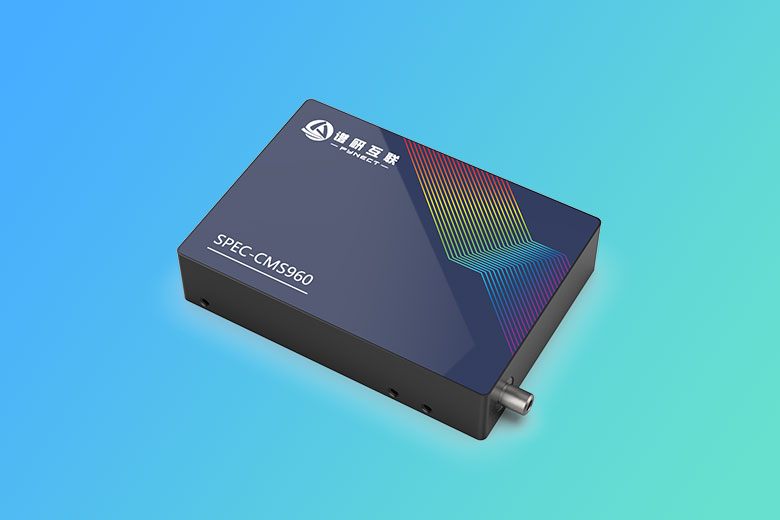
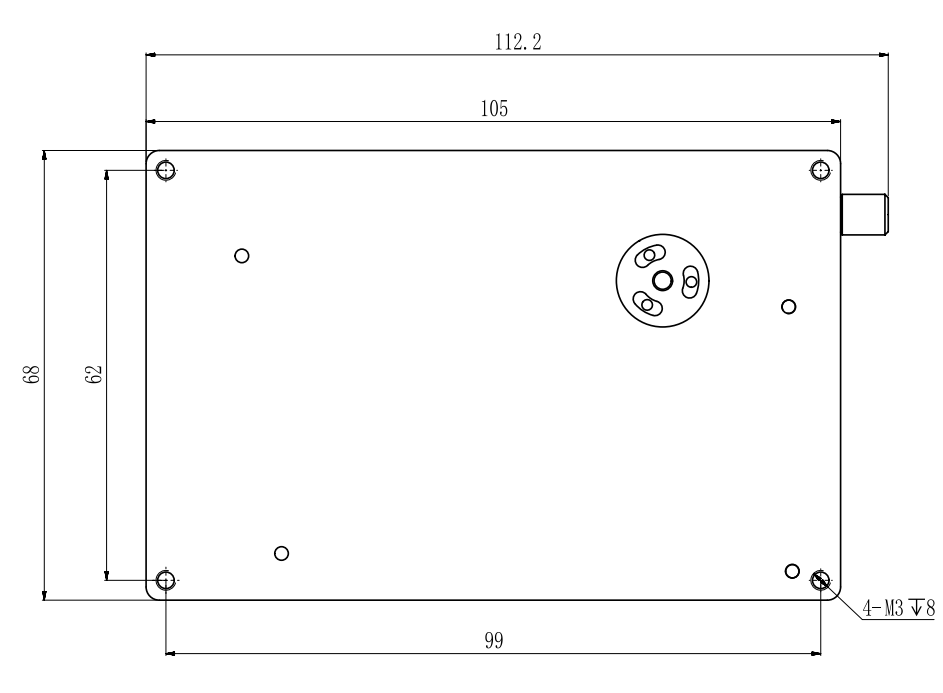
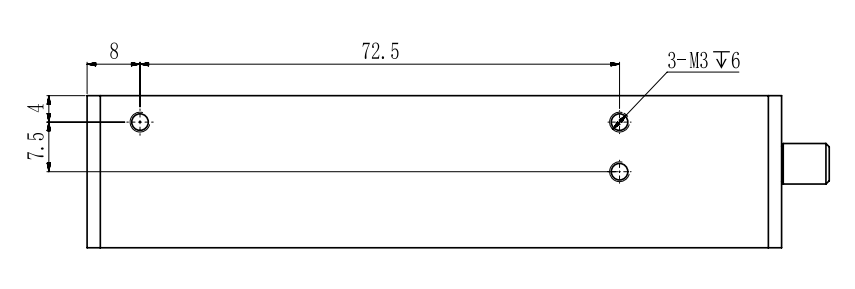
3. Common Setups
The SPEC-CMS960 combines with light sources, fibers and sampling accessories to build various optical paths. Broadband coverage serves both routine visible measurements and UV/short-wave NIR applications.
| Setup | Typical configuration | Main use |
|---|---|---|
| Integrating sphere source test | Source + integrating sphere + fiber | Spectral distribution, chromaticity and optical power of LEDs, xenon and halogen lamps |
| Liquid transmittance | Source + cuvette holder + fiber | Solution transmittance, absorbance and concentration analysis |
| Immersion probe | Source + immersion transmission probe | Reaction liquids, fluids, online liquid absorption |
| Solid transmittance | Source + transmission holder | Lenses, filters, films and transparent plastics |
| Reflectance probe | Source + reflectance probe | Color, surface reflectance, coating and material differences |
| Fluorescence | Excitation source + reflectance probe or sphere | Fluorescence emission spectra |
4. Principle
4.1 Fiber spectrometer composition
Fiber spectrometers typically use a Czerny-Turner optical layout. Polychromatic light from an external source, sample or probe enters through the SMA905 interface; the entrance slit defines the beam, which is then dispersed by a collimating mirror, grating and focusing optics onto different pixels of a linear array detector. Each pixel corresponds to a wavelength band; after ADC conversion and wavelength calibration, the software reconstructs the wavelength-ordered spectrum.
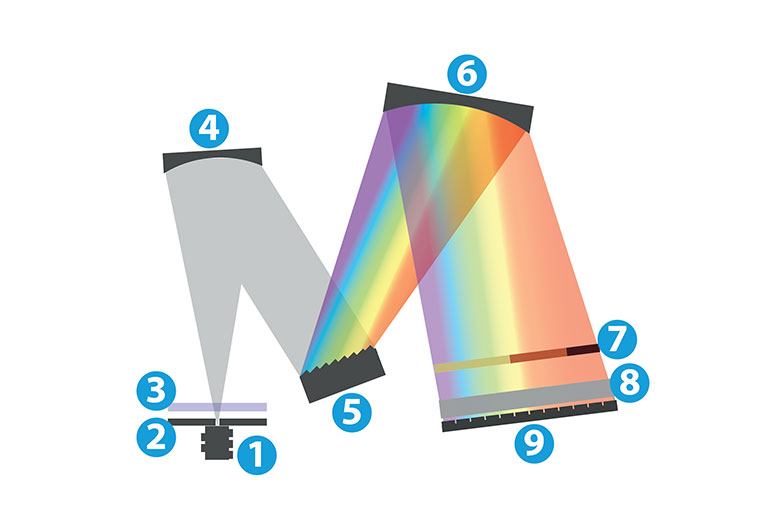
Typical components:
| Component | Function |
|---|---|
| Input interface | Connects fiber and aligns to the entrance slit for repeatability and mechanical strength |
| Slit | Controls throughput; affects sensitivity and optical resolution |
| Long-pass or balancing filter | Filters short-wave stray light per band and application; improves spectral response uniformity |
| Collimating mirror | Converts diverging slit light into a collimated beam onto the grating |
| Grating | Disperses light by wavelength - the core element for range and resolution |
| Order-sorting filter | Suppresses overlap of second- and higher-order diffraction with first-order spectra - especially important for broadband instruments |
| Cylindrical lens or focusing group | Focuses the dispersed band onto the detector active area, improving energy utilization |
| Linear array detector | Pixels receive different wavelengths and convert them into digitizable electrical signals |
The SPEC-CMS960's broadband capability comes from the combined grating, slit, filter and detector configuration. Selection balances wavelength range, resolution and sensitivity: more grating lines raise resolution but narrow the range; wider slits raise signal but lower resolution; broader bands demand stronger order-sorting, response balancing and calibration consistency.
5. Applications
- Light source testing: center wavelength, FWHM, spectral distribution and chromaticity of LEDs, lasers, xenon, halogen and deuterium lamps.
- Transmittance measurement: filters, lenses, films, transparent materials and liquid samples.
- Absorbance analysis: cuvette solutions, online flow cells and immersion probe setups.
- Reflectance measurement: surface, color samples, coatings, films and diffuse samples.
- UV-enhanced testing: with deuterium or xenon flash lamps for UV absorption, UV transmittance and UV response.
- Online integration: RS485 or Modbus connection to automation equipment for long-term online acquisition.
6. Selection and Configuration
6.1 Slit Selection
| Slit | Characteristics | Recommendation |
|---|---|---|
| 10μm / 25μm | Higher resolution, lower throughput | Narrow peaks and higher-resolution needs |
| 50μm | Balanced resolution and signal | Default for most general measurements |
| 100μm / 200μm | Stronger signal, lower resolution | Weak light, fluorescence or low-illumination scenarios |
6.2 Light Sources and Accessories
- UV testing: pair with deuterium or xenon flash lamps and UV-transparent fibers and accessories.
- Visible and short-wave NIR: halogen lamps, LEDs, integrating spheres, reflectance probes or cuvette holders.
- Liquid absorbance: choose path length per sample absorption to avoid weak signals or saturation.
- Online scenarios: prefer RS485 or serial Modbus for multi-device networking and industrial control integration.
7. Precautions
- Warm up the source and acquire dark and reference spectra after connecting all components.
- Re-acquire references after changing sources, fibers, probes, cuvettes or integration time.
- UV bands demand higher-grade fiber, cuvette and window materials - confirm sufficient transmittance in the target band.
- Keep SMA905 ports and fiber end faces clean - avoid dust, fingerprints and scratches.
- Fix fiber and accessory positions during long-term online measurement to reduce baseline drift from mechanical disturbance.
- For quantitative analysis, build calibration models with stable sample sets and record integration time, averaging, source state and ambient temperature.