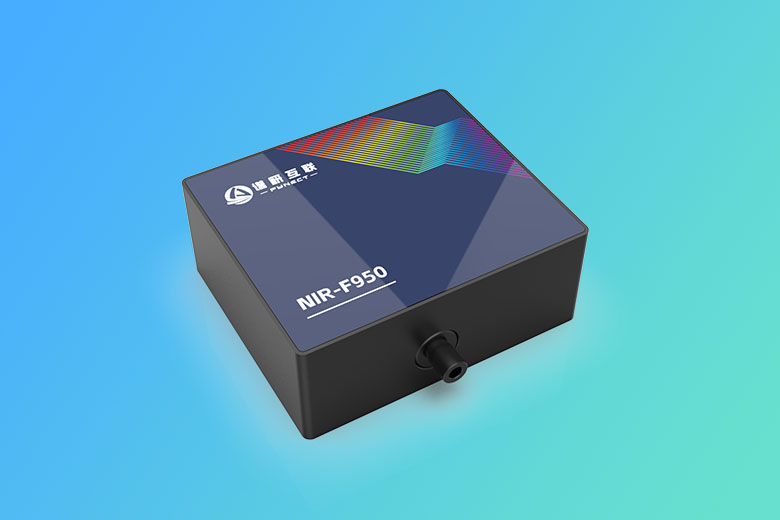
1. Key Features
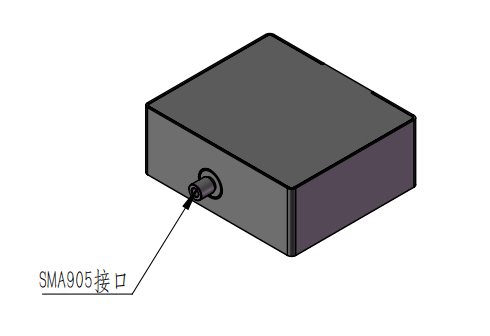
- Near-infrared fiber interface design: SMA905 fiber interface; works with cuvette holders, immersion probes, reflectance probes, integrating spheres and other accessories to flexibly build transmission, reflection and online detection optical paths.
- 900-1700nm nominal coverage: 256-pixel InGaAs linear array detector, suited for NIR characteristic absorption analysis of moisture, oils, alcohols, organics and polymer materials; the effective usable range is recommended to be evaluated at about 950-1700nm.
- High signal-to-noise acquisition: Typical SNR of 5000:1, suited for NIR experiments or instrument integration requiring stable repeated acquisition and chemometric modeling.
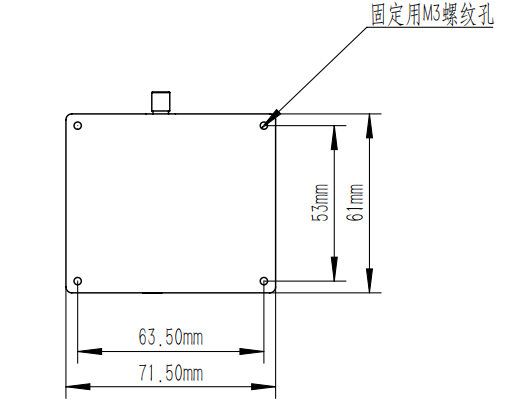
- Compact professional design: 71.5mm x 61mm x 28mm body, easy to embed in online instruments, portable analyzers or lab-built optical paths.
- Multiple communication interfaces: Type-C, RS232 and RS485 for connecting to PCs, industrial computers, MCUs or host systems.
- Ready for secondary development: Underlying communication protocol and development support available; suitable for packaging your own SDK or integrating into automated inspection workflows.
2. Specifications
2.1 Technical Parameters
| Item | Parameter |
|---|---|
| Model | NIR-F950 |
| Type | Near-infrared fiber spectrometer |
| Nominal wavelength range | 900-1700nm (Note 1) |
| Recommended usable range | Approx. 950-1700nm |
| Optical resolution | 7nm (default 25μm slit) |
| Dark noise RMS | ~20counts@10ms |
| Dynamic range | 3200:1@10ms (Note 2) |
| Wavelength accuracy | Typ. +/-0.5nm |
| Signal-to-noise ratio | 3000:1@10ms@1250nm (Note 3) |
| Grating | 150lines/mm |
| Slit size | 25μm (default); 50μm optional. 25μm recommended. (Note 4) |
| Detector | Hamamatsu G13913-256FG (uncooled) |
| Optical interface | SMA905 |
| Communication | Type-C / RS232 / RS485 |
| Protocol | Custom protocol |
| Power | 5V / 1A |
| Dimensions | 71.5mm x 61mm x 28mm |
| Weight | Approx. 200g |
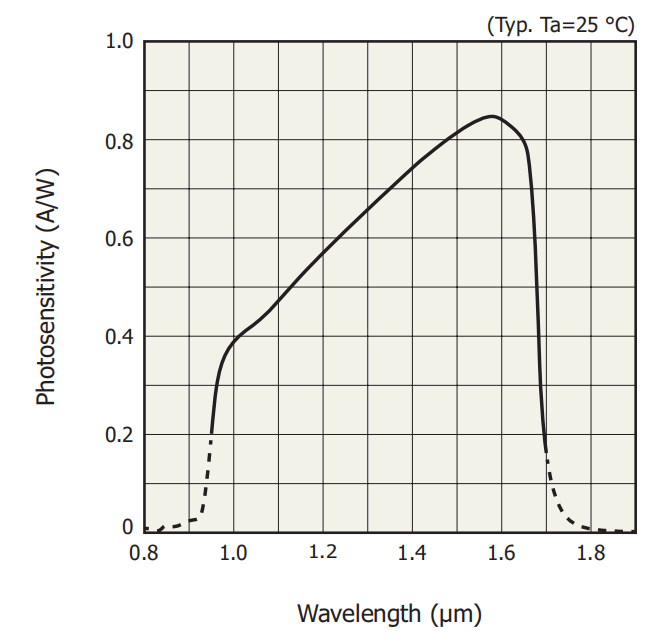
Note 1: The detector cannot achieve full response over 900-1700nm; the actual effective range is 945-1700nm. See the quantum efficiency curve of the Hamamatsu linear InGaAs detector G13913-256FG below; the dashed region has no response.
Note 2: Dynamic range is the ratio of full-scale intensity 65535 to dark-noise RMS at a fixed 10ms integration time.
Note 3: SNR is the ratio of the intensity at 1250nm to the dark-noise RMS at a fixed 10ms integration time, with intensity near full scale.
Note 4: With only 256 pixels, grating ruling density and slit are no longer the main factors limiting optical resolution; the 25μm and 50μm slits make little difference. Note the difference from the 2048-pixel silicon detectors used in the 200-1100nm range.
2.2 Appearance and Dimensions
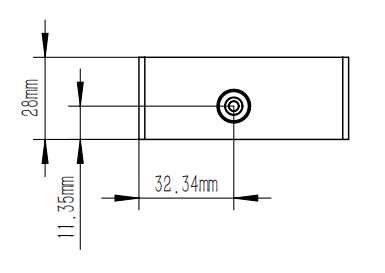
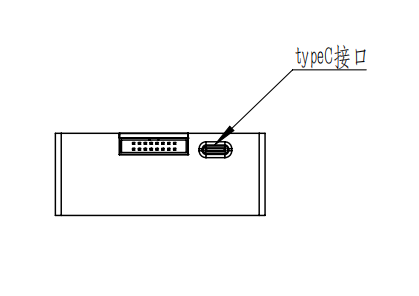
2.3 Wavelength Range Notes
The NIR-F950 uses an InGaAs linear array detector, suited for NIR absorption measurements near 1.0-1.7μm. The nominal wavelength range in the datasheet is 900-1700nm, but the detector's actual response gradually declines at the short-wavelength end, so 950-1700nm is recommended as the primary effective range for modeling and selection.
This range covers the overtone and combination absorption of hydrogen-containing groups such as O-H, C-H and N-H, and is commonly used for moisture, alcohol, oil, protein, organic solvent, plastic and agricultural product quality analysis.
3. Common Optical Paths
The fiber spectrometer itself only acquires spectra; actual measurements require a light source, fibers and sampling accessories matched to the sample state. Typical configurations for the NIR-F950:
| Path type | Typical configuration | Target samples |
|---|---|---|
| Liquid transmission | Tungsten-halogen source + fiber + cuvette holder | Solutions, beverages, oils, transparent or translucent liquids |
| Immersion transmission | Source + immersion probe | Reaction liquids, fermentation broths, fluid process monitoring |
| Diffuse reflectance | Tungsten-halogen source + reflectance probe | Powders, granules, solid surfaces |
| Integrating-sphere reflectance | Source + integrating sphere | Sheets, coatings, color and reflectance measurement |
| Online flow cell | Source + flow cuvette or flow cell | Pipeline liquids, online concentration monitoring |
4. Principle
4.1 Fiber Spectrometer Optical Principle
Fiber spectrometers typically use a Czerny-Turner optical layout. Polychromatic light from the external source, sample or probe enters the spectrometer through the SMA905 interface; the entrance slit defines the incoming beam, which is then dispersed by the collimating mirror, grating and focusing optics before landing on different pixels of the linear array detector. Each pixel corresponds to a wavelength segment; after ADC conversion and wavelength calibration, the software reconstructs the spectrum versus wavelength.
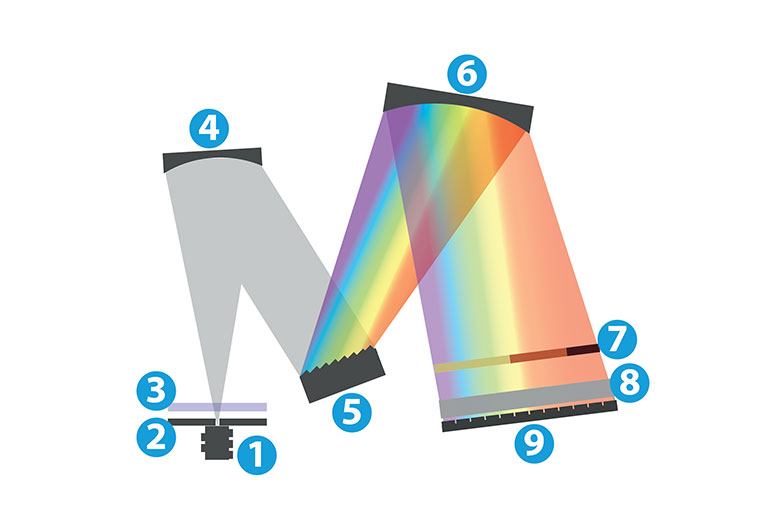
Typical components include:
| Component | Function |
|---|---|
| Light entrance interface | Connects the fiber and aligns it to the entrance slit, ensuring optical-path repeatability and mechanical connection strength |
| Slit | Controls the light flux entering the spectrometer, affecting both sensitivity and optical resolution |
| NIR AR or filter optics | Increase transmittance in the target band and reduce stray light outside it |
| Collimating mirror | Turns the diverging light from the slit into a collimated beam that stably illuminates the grating |
| Grating | Disperses polychromatic light by wavelength; the core element determining wavelength range and resolution |
| Focusing optics | Focus the dispersed spectral band onto the detector's active area, improving light utilization |
| InGaAs linear array detector | Different pixels receive light at different NIR wavelengths and convert it into electrical signals ready for digitization |
The NIR-F950 targets the 900-1700nm NIR band; its internal optical configuration must balance InGaAs detector response, grating efficiency and NIR optical coatings. Selection requires a trade-off among wavelength range, resolution and sensitivity: the higher the grating ruling density, the higher the resolution usually is, but the narrower the coverage; the wider the slit, the stronger the signal but the lower the resolution; NIR applications must also consider source intensity, fiber transmittance and sample absorption.
5. Applications
- Food & agricultural products: moisture, oil, protein, sugar content and quality difference analysis.
- Alcohol & solvents: concentration modeling of ethanol, water, organic solvents and mixtures.
- Oil testing: C-H absorption analysis of edible oils, lubricants, fuel oils, etc.
- Polymer materials: plastic identification, resin batch variation and additive-related detection.
- Pharmaceutical & chemical: raw material identification, formulation ratio, reaction process and residual solvent monitoring.
- Online instrument integration: fixed inspection stations built with sources, fiber probes and industrial control systems.
6. Usage and Integration Guidance
6.1 Light Sources and Accessories
- For NIR measurements, use a stable tungsten-halogen source, preferably a continuous source covering 900-1700nm.
- For transmission measurements, choose a suitable path length based on sample absorption. Water-containing samples absorb strongly above 1400nm; use a short-path cuvette or dilute the sample when necessary.
- For reflectance measurements, keep probe angle, measurement distance and sample compaction consistent to reduce the effect of scattering variations on the model.
- For online measurements, fix the fiber bend radius and connections to avoid baseline drift from fiber movement.
6.2 Acquisition and Modeling
- Re-acquire the reference spectrum after every change of optical path, source, sample cell or probe position.
- Before modeling, evaluate dark noise, reference stability, integration time, averaging and temperature variation.
- NIR quantitative analysis usually requires chemometric methods such as PLS, PCA and SVM, with preprocessing such as smoothing, SNV, MSC, and first or second derivatives.
- For strongly absorbing liquids, turbid samples and highly scattering solids, first optimize path length, dilution, sample preparation or measurement method before model training.
7. Ordering and Bundles
| Type | Recommended configuration | Notes |
|---|---|---|
| Standard unit | NIR-F950 fiber spectrometer | Includes SMA905 fiber interface; suitable for building NIR fiber optical paths |
| Common source | Tungsten-halogen light source | For continuous 900-1700nm NIR illumination |
| Fiber accessories | SMA905 fiber, reflectance probe, immersion probe | Select according to transmission, reflection or online measurement method |
| Liquid accessories | Cuvette holder, quartz cuvette, flow cell | For liquid transmission and online liquid measurement |
| Solid accessories | Reflectance probe holder, integrating sphere | For powder, granule, sheet and surface reflectance measurement |
8. Precautions
- The NIR-F950 is a fiber spectrometer; a complete measurement requires a matching light source and sampling accessories.
- Response at the short-wavelength end of the NIR band is affected by detector quantum efficiency; base practical modeling on stable spectra within the effective response range.
- Keep the SMA905 interface clean; a contaminated fiber end face markedly reduces signal and introduces repeatability errors.
- Do not over-bend fibers to avoid transmittance loss or fiber damage.
- In online applications, watch environmental temperature, source warm-up, mechanical fixing and electromagnetic interference; use fixed brackets and shielded cables where necessary.